Walk into two newly built homes. The first one feels fine. Comfortable. Predictable. Hollow-core doors painted white. Visible hinges. Standard knobs. Everything works exactly as expected.
Then you step into the second house. Nothing immediately jumps out at you. Not at first. The walls seem cleaner somehow. The hallways feel calmer. The doors almost disappear into the architecture instead of interrupting it. They close with a quiet, solid click — not a slam, not a rattle. Even people who know absolutely nothing about interior design tend to pause for a second.
Something feels different. That “something” is often the doors.
People will spend months choosing hardwood flooring, obsess over cabinet hardware, compare quartz samples under three different light bulbs and then accept whatever builder-grade doors happen to come with the house.
Doors become background noise.
Over the past decade, architects, designers, and homeowners across North America have increasingly turned toward European interior doors. Not because they’re trendy. Trends have short attention spans. European door systems have been evolving for generations, and they reflect a fundamentally different philosophy about how interior architecture should work. That philosophy is at the heart of the discussion around European doors vs American doors comparison. It’s not simply a matter of appearance — it’s engineering. Construction, materials, hardware, acoustics, longevity, even the way a room feels after the door closes.
American interior doors certainly have their place. Millions of homes use them successfully every day. They’re familiar, widely available, and often less expensive upfront. European doors ask a different question. Not “What’s the simplest door that separates two rooms?” They ask, “How should this door become part of the architecture itself?”
The answers tend to produce very different products.
Different Design Philosophies Lead to Different Doors
If you’ve ever compared European kitchens with traditional American kitchens, you’ve probably noticed something. European designers love integration: cabinets align perfectly, handles disappear, lines continue uninterrupted. Everything feels intentional. Interior doors follow exactly the same philosophy.
American doors, on the other hand, traditionally celebrate the door itself. Raised panels. Decorative molding. Wide casings. Visible hinges. Pronounced trim. Neither approach is objectively wrong—they’re simply solving different design problems.
European Doors Blend Into the Architecture
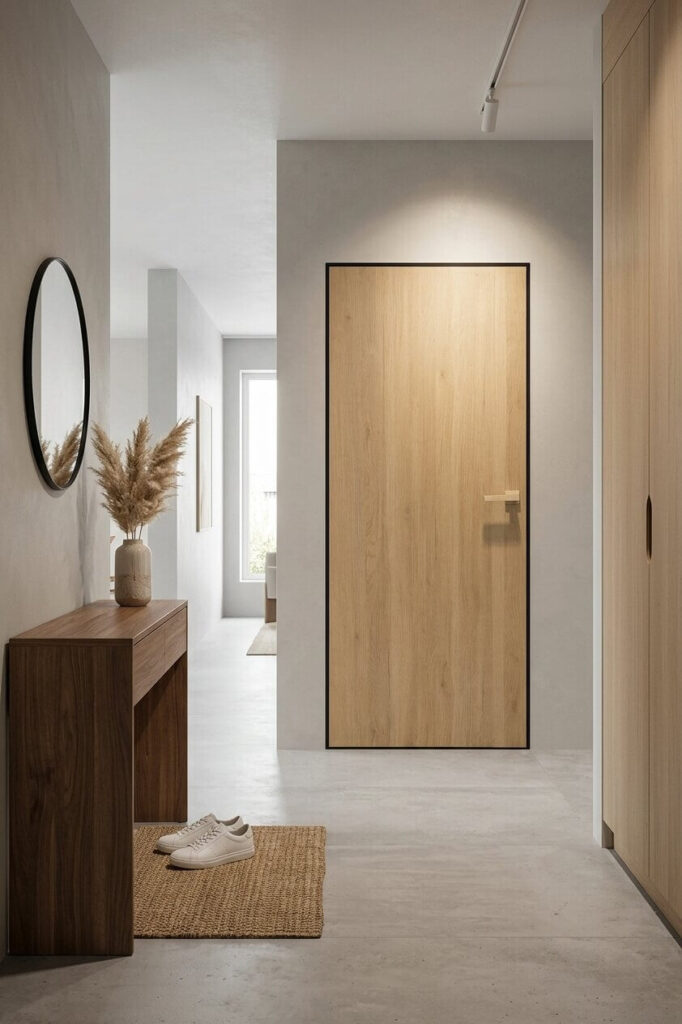
Look down a modern hallway featuring flush European doors. The wall continues almost uninterrupted. The surfaces align. Instead of creating visual interruptions every few feet, the doors become part of the surrounding architecture. It’s surprisingly calming.
Hard to explain until you’ve stood in front of it.
Your eyes stop bouncing from frame to frame. Instead, they travel naturally through the space. Minimalism often gets mistaken for emptiness. Good minimalism is incredibly disciplined, though. Every line has a purpose. Every shadow matters.
European interior doors embrace that discipline.
American Doors Often Emphasize Decoration
Traditional American construction has long favored decorative trim. Colonial styles, craftsman details, raised panels, casing profiles, ornamental moldings — these elements create warmth and familiarity. There’s history behind them. Walk into a century-old American home and elaborate trim feels perfectly natural.
Install the same door inside a sleek contemporary penthouse filled with floor-to-ceiling glass, however and the conversation changes.
Modern architecture often asks for quieter details. European systems answer that request remarkably well.
Architecture Has Changed
Homes today look different than they did thirty years ago. Open floor plans. Larger windows. Continuous flooring. Hidden lighting. Cleaner ceilings. Minimal kitchens. It only makes sense that doors would evolve alongside everything else, yet many American interior doors still follow construction standards established decades ago.
European manufacturers adapted earlier. Perhaps because space has always been more precious in European cities. Perhaps because modern architecture became mainstream sooner. Maybe both. Either way, the result speaks for itself.
Construction Quality Begins Inside the Door
Here’s something most homeowners never see. The inside. A finished door hides its construction remarkably well. That’s unfortunate. Because construction determines almost everything: weight, rigidity, acoustic performance, longevity, daily feel.
Two doors can look nearly identical from across the room while behaving completely differently after years of use. The difference lives inside.
Hollow-Core Doors Dominate the American Market
Walk through a typical American home built over the past several decades. Odds are many of the interior doors are hollow-core. Despite the name, they aren’t completely empty. Most contain lightweight honeycomb cardboard or similar internal structures designed to reduce weight and manufacturing costs.
There’s nothing inherently defective about hollow-core construction. It serves a purpose. Lower cost, easy installation, reduced shipping expenses. For many builders, that’s enough. For homeowners planning to live in a house for decades it isn’t.
European Doors Often Feel More Solid
European interior doors frequently use engineered solid cores or dense composite constructions. Immediately noticeable. Lift one, open one, close one. The difference isn’t subtle. Heavier doors generally resist twisting, warping, dents, and everyday impacts more effectively than lightweight hollow-core models.
Not because weight automatically equals quality — because thoughtful engineering often accompanies it.
There’s confidence in the movement. Like shutting the door of a well-built luxury car instead of an economy hatchback. Both close. One simply feels different.
Stability Matters Over Time
Wood moves, humidity changes, seasons change, buildings settle. Every door experiences these realities. Quality engineering minimizes their effects.
European manufacturers have spent decades refining laminated core structures, engineered wood technology, and precision manufacturing techniques that help doors remain stable across changing environmental conditions.
That’s especially valuable inside climate-controlled modern homes where alignment matters. Tiny shifts become noticeable surprisingly quickly. Doors remind us — usually by refusing to latch properly.
Precision Manufacturing Changes Everything
Mass production isn’t automatically bad. Poor tolerances are.
Many premium European manufacturers build door systems with remarkably tight production standards. Frames, panels, edges, hardware locations. Everything aligns with impressive consistency. Precision sounds boring until you’ve lived with doors that rub the floor every winter. Or develop uneven gaps six months after installation.
Suddenly boring becomes very attractive.
Hardware Isn’t an Accessory — It’s Part of the System
People often buy American interior doors separately. Door, frame, hinges, lockset, strike plate, handle — each component may come from a different manufacturer. There’s flexibility in that approach. There are also variables.
European systems tend to think differently. The entire assembly is engineered together — almost like one product instead of several unrelated parts sharing the same opening.
Concealed Hinges Create Cleaner Lines
Traditional hinges remain visible whenever the door closes. Nothing unusual about that. We’ve all grown accustomed to them. Concealed hinges disappear entirely when the door is shut. No exposed metal. No decorative plates. No visible screws. Just a continuous surface.
Clean walls become even cleaner. Minimal interiors become genuinely minimal. It’s one of those details people don’t consciously identify — they simply feel the result.
Magnetic Locks Change the Closing Experience
Here’s a small innovation with surprisingly large consequences. Traditional latch mechanisms rely on angled metal components that scrape against each other every time the door closes. Magnetic locks behave differently.
The latch remains hidden until it aligns with the strike plate. Then it snaps. Quietly. No scraping, no rattling. An oddly satisfying thing to behold.
Tiny improvement. Daily experience. Years of repetition. Those small moments add up.
Better Hardware Lasts Longer
Doors are mechanical objects. They move constantly. Quality hinges maintain alignment. Quality locks continue operating smoothly. Quality handles resist looseness after years of use.
Premium European manufacturers generally view hardware as part of the engineering process rather than decorative accessories selected near the end of production. That mindset influences durability. Quite a bit.
Sound, Privacy, and Everyday Comfort
Here’s a feature many homeowners don’t consider until after moving in. Noise. Or more accurately, the lack of it.
Interior doors aren’t only visual elements — they’re acoustic barriers. Some are better than others.
Hollow Doors Don’t Stop Much Sound
Children playing downstairs. Television in the living room. Phone calls. Kitchen activity. Dogs deciding that delivery trucks represent an existential threat. Lightweight hollow-core doors struggle to reduce these sounds significantly.
Physics isn’t especially forgiving. Less mass generally means less sound isolation. Simple equation.
European Door Systems Often Improve Acoustic Performance
Heavier cores, better perimeter alignment, precise installation — these elements combine to improve sound reduction between rooms.
No interior door creates complete silence. That’s not the goal. The goal is comfort. Privacy. A quieter bedroom. A calmer home office. A nursery that stays asleep while someone unloads groceries. Real life, essentially.
Closing a Door Should Feel Final
Think about hotel rooms. Really good ones.
The door closes. The hallway disappears. That sensation comes from engineering as much as architecture. Many premium European systems recreate a similar experience inside residential homes.
The door doesn’t merely swing shut — it completes the room. There’s something deeply satisfying about that. Difficult to measure, easy to appreciate.
European Doors Are Designed as Complete Systems, Not Individual Parts
One of the biggest differences between European and traditional American doors isn’t the slab. It’s everything surrounding it.
Many American interior doors are purchased almost like separate ingredients. The door comes from one manufacturer, the frame from another, the hinges from someone else, the handle is selected later, the lock arrives in another box. Every individual component may be perfectly good. The challenge comes from making independent parts behave like one perfectly engineered system.
Sometimes they do. Sometimes they argue with each other for years.
European manufacturers generally take another path. The frame, concealed hinges, magnetic lock, strike plate, seals, and door panel are engineered together from the beginning. Nothing feels accidental. The clearances are intentional. The hardware locations are predetermined. Even the pressure required to close the door has often been carefully considered.
The result is surprisingly noticeable during everyday use. Not louder. Quieter. Everything simply works without asking for attention, which is probably the highest compliment a door can receive.
Customization Goes Far Beyond Paint Colors
Ask someone about customizing an American interior door. The conversation often begins with color. Maybe panel style. Possibly hardware finish.
European manufacturers usually start somewhere else. “What kind of architecture are we building?” That’s a much broader question.
Flush Doors Create Architectural Continuity
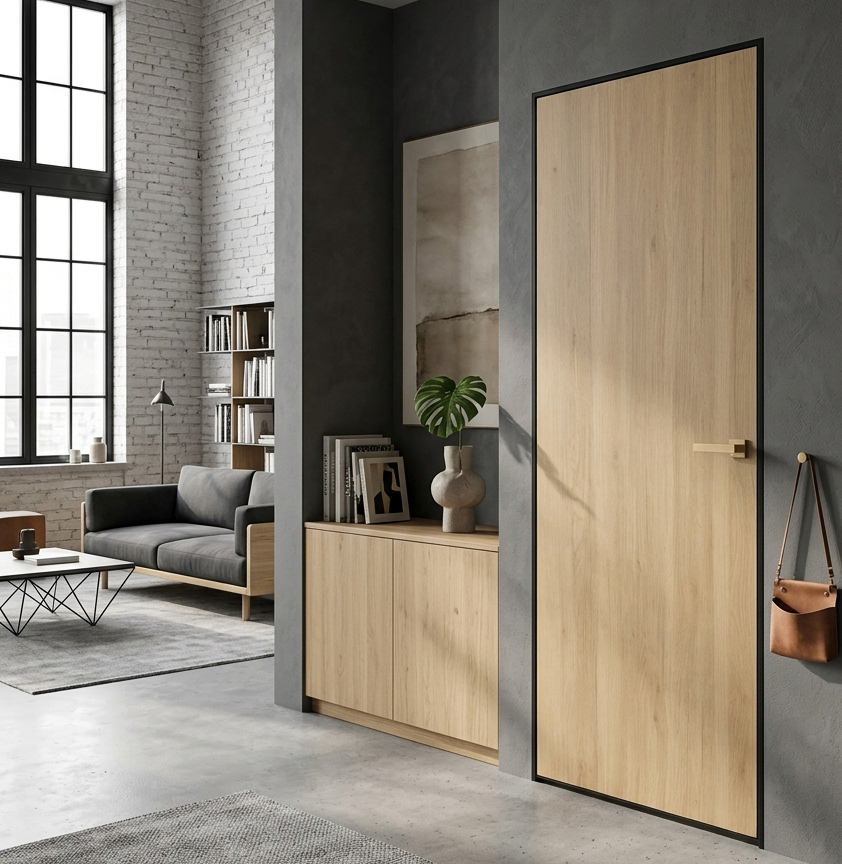
Flush doors have become closely associated with modern European interiors for good reason. Instead of projecting outward with decorative panels, the surface remains perfectly flat. Simple, clean, almost understated.
That simplicity gives surrounding materials more room to breathe. Stone, wood, concrete, wallpaper, artwork — nothing competes unnecessarily.
Removing visual noise often makes the remaining details feel richer rather than emptier. Architecture occasionally behaves like music. Silence matters too.
Invisible Frames Change the Wall Itself
Some premium European systems eliminate traditional trim almost entirely. The frame becomes hidden within the wall.
When the door closes it appears almost as another section of drywall. Visitors sometimes hesitate before opening it. Not because it’s difficult to find — because their brains briefly interpret it as part of the architecture instead of an object attached to it.
It’s subtle until you live with it. Then conventional door casings suddenly feel surprisingly bulky.
Finishes Reflect Contemporary Design
Modern European manufacturers offer an enormous range of finishes. Natural oak. American walnut. Ash. Matte lacquer. High-pressure laminates. Textured wood veneers. Paint-ready surfaces. Stone-inspired textures. Ultra-matte finishes that resist fingerprints. The point isn’t endless choice — it’s architectural flexibility.
The same door system can comfortably fit a minimalist penthouse, a Scandinavian-inspired home, or a warm contemporary interior without looking out of place. That’s difficult to achieve with highly decorative panel designs.
Decoration tends to choose the room. Minimalism lets the room choose itself.
Durability Is Measured in Years, Not Showroom Visits
Every new door looks good. The better question arrives later. Five years. Ten years. Fifteen. Daily use becomes remarkably honest.
Children slam doors. Dogs scratch lower panels. Humidity shifts. Furniture bumps corners. Life happens. Quality construction doesn’t prevent life, it simply survives it more gracefully.
Better Edges Resist Everyday Damage
Door edges experience constant abuse. Suitcases. Laundry baskets. Vacuum cleaners. Moving furniture. Toy trucks driven by ambitious four-year-olds. Premium European doors often use thicker edge construction, engineered materials, or reinforced designs that better tolerate everyday impacts.
Small dents become less common. Sharp corners remain cleaner. The difference accumulates quietly. Just like wear itself.
Finish Quality Matters
Paint isn’t merely decoration. It’s protection. The same applies to veneers and laminates.
High-quality factory finishes typically provide greater consistency than many field-painted doors. Color remains more uniform. Surface texture stays smoother. Maintenance often becomes easier. You stop thinking about touch-up paint every few months and that feels surprisingly liberating.
Precision Hardware Ages Better
Loose handles rarely happen overnight. They loosen gradually. Hinges develop tiny amounts of play. Latches begin sticking. Everything starts with something almost invisible. Well-engineered hardware slows that process considerably. Not because physics stops applying — because better components tolerate years of movement more effectively.
A door may open and close thousands of times annually. Multiply that by twenty years. Now imagine the importance of precision. Suddenly hinges seem much more interesting.
Long-Term Value Isn’t the Same as Initial Price
Here’s where discussions around European doors vs American doors comparison sometimes become overly simplistic.
People compare purchase prices. Then stop. That isn’t really how value works.
Imagine buying two cars. One costs half as much but needs replacing every three years. The other lasts fifteen. Which was cheaper? Depends which year you’re asking.
Doors deserve similar thinking.
Renovations Last For Decades
Unlike paint colors or decorative lighting, interior doors rarely change during ownership.
Most homeowners replace them once. Maybe never. That makes long-term quality considerably more important than short-term savings.
Especially inside custom homes.
Premium Materials Support Property Value
Real estate professionals often talk about kitchens and bathrooms. Fair enough. Those spaces matter.
Interior architectural details increasingly influence buyer perception as well. Modern trim. Flush doors. Premium hardware. Clean lines. They’re difficult to describe in listing photos. Easy to feel during showings.
Buyers may never say, “We purchased this home because of the concealed hinges”. They might absolutely say, “This house feels different”. Sometimes that’s enough.
Maintenance Has a Cost Too
Adjusting doors. Repainting chipped edges. Replacing inexpensive hardware. Correcting warped panels. Individually, none of these expenses feel enormous. Collectively they quietly become part of ownership.
High-quality systems reduce many of those interruptions. Not completely but less maintenance has value. Even when accountants forget to include it.
Sustainability Through Longevity
Environmental conversations often focus on manufacturing. That’s important. There’s another side. Products that last longer generally require fewer replacements. Fewer replacements often mean fewer resources consumed over decades. Simple concept, powerful consequences.
Many European manufacturers also source engineered wood responsibly, optimize material usage, and build products intended for extended service life rather than quick replacement cycles.
Sustainability isn’t only about recycling — sometimes it’s about not needing another door for thirty years. Durability can be remarkably environmentally friendly.
Common Misconceptions About European Interior Doors
Let’s clear up a few things because myths travel surprisingly fast.
“They’re Only for Ultra-Modern Homes”
Not true.
Yes, European doors naturally complement contemporary architecture. They also work beautifully inside transitional interiors, Scandinavian homes, warm minimalist spaces, renovated historic properties, and custom residences blending traditional materials with modern details.
The key isn’t style. It’s proportion. Simple doors adapt more easily than heavily decorative ones.
“They’re Impossible to Install”
Quality installation absolutely matters. No argument there. Precision systems deserve experienced installers. That doesn’t make them impossible — it simply means proper preparation produces better results.
Just like tile. Or cabinetry. Or hardwood flooring. The product rewards careful craftsmanship.
“They’re Only About Looks”
Appearance introduces people to European doors. Performance usually convinces them to stay.
Solid construction, magnetic locks, better acoustics, integrated hardware, flush alignment — these aren’t decorative features but functional improvements. The aesthetics simply happen to be excellent as well.
Which Door Is Right for Your Home?
There’s no universal answer. There never is. Traditional American interior doors remain perfectly appropriate for many homes. Historic renovations. Classic architecture. Budget-conscious projects. Large developments. They continue serving millions of homeowners successfully.
European systems simply prioritize different things. Architectural continuity. Precision. Engineering. Long-term refinement. Cleaner aesthetics. Integrated hardware. Superior everyday experience. If your vision includes minimalist architecture, contemporary interiors, luxury finishes, custom construction, or simply investing once instead of upgrading later, European doors become increasingly compelling.
The conversation surrounding European doors vs American doors comparisons isn’t really about declaring one country better than another. It’s about understanding two different philosophies of design. One treats the door primarily as a building component. The other treats it as an architectural element. Those sound similar but they aren’t.
One separates rooms. The other quietly shapes the experience of moving through them. That difference becomes obvious every single day. You hear it when the magnetic latch closes without scraping. You notice it when sunlight slides uninterrupted across a flush wall. You appreciate it years later when the door still hangs perfectly straight despite thousands upon thousands of openings.
People spend fortunes searching for features that make a home feel luxurious. Imported stone. Designer lighting. Custom furniture. Yet one of the first things every guest touches is a door. They reach for the handle almost automatically. Open it, close it, move on. The moment lasts maybe three seconds. Almost forgettable. Except quality has a peculiar habit of introducing itself in very small moments.
A perfectly balanced door. A silent magnetic click. A wall that flows without interruption. Nothing shouts. Everything simply feels right. The best European doors don’t ask to become the center of attention — they quietly improve the architecture around them.