Interior doors rarely make the shortlist of exciting home upgrades. Kitchens do. Flooring certainly does. Bathrooms steal plenty of attention. Lighting gets entire Pinterest boards devoted to it. Doors? They’re usually chosen somewhere near the end of construction, almost as an afterthought. Which is odd, because they’re among the few architectural elements you interact with every single day. You open them hundreds of times every week. You hear them close. You see them from almost every room in your home. They’re never really in the spotlight until someone installs better ones.
Over the past several years, American homeowners, architects, and interior designers have become increasingly interested in European interior doors. Luxury custom homes, upscale renovations, high-end condominiums, even boutique office spaces are embracing a design approach that has been common throughout Europe for decades.
Naturally, one question comes up again and again. “What are European interior doors?” The simple answer is that they’re premium interior door systems designed with a strong emphasis on modern architecture, integrated hardware, precision engineering, and minimalist aesthetics.
The complete answer, well, that’s considerably more interesting since European doors aren’t simply another style of door. They’re a different way of thinking about interior architecture.
European Interior Doors Are Built as Complete Systems
One of the biggest misconceptions among American buyers is that a European door is simply a prettier slab with a nicer finish. Not quite. Actually, not even close.
Traditional American doors are often assembled from separate components. The slab comes from one manufacturer. The frame from another. The hinges are purchased separately. The lockset comes in its own box. The handle is selected later. Everything eventually comes together at the job site.
European manufacturers usually approach things differently. The door, frame, concealed hinges, magnetic lock, strike plate, seals, and installation system are engineered together from the beginning. Nothing is accidental. The components are designed to work with one another instead of simply fitting together.
Building a traditional door system can sometimes resemble assembling a custom desktop computer from individual parts. Building a premium European door system feels closer to buying a finely engineered laptop where every component was designed as part of the same product. Different philosophy. Different result.
That attention to integration becomes noticeable every single time you open the door.
Minimalism Doesn’t Mean Less Quality
Here’s a common misunderstanding. People see clean lines. Flat panels. Hidden hinges. Minimal trim. They assume the design must be simpler. Actually it’s usually more complicated.
Minimal architecture is surprisingly demanding. When decorative moldings disappear, craftsmanship has nowhere to hide. Every reveal becomes visible. Every alignment matters. Even a two-millimeter mistake suddenly catches your eye. European manufacturers have spent decades refining production methods that allow these minimalist designs to feel effortless. They aren’t effortless at all — they’re incredibly precise.
That’s part of what defines what are European interior doors beyond their appearance. The beauty comes from accuracy, not ornament.
Flush Doors Create Clean Architectural Lines
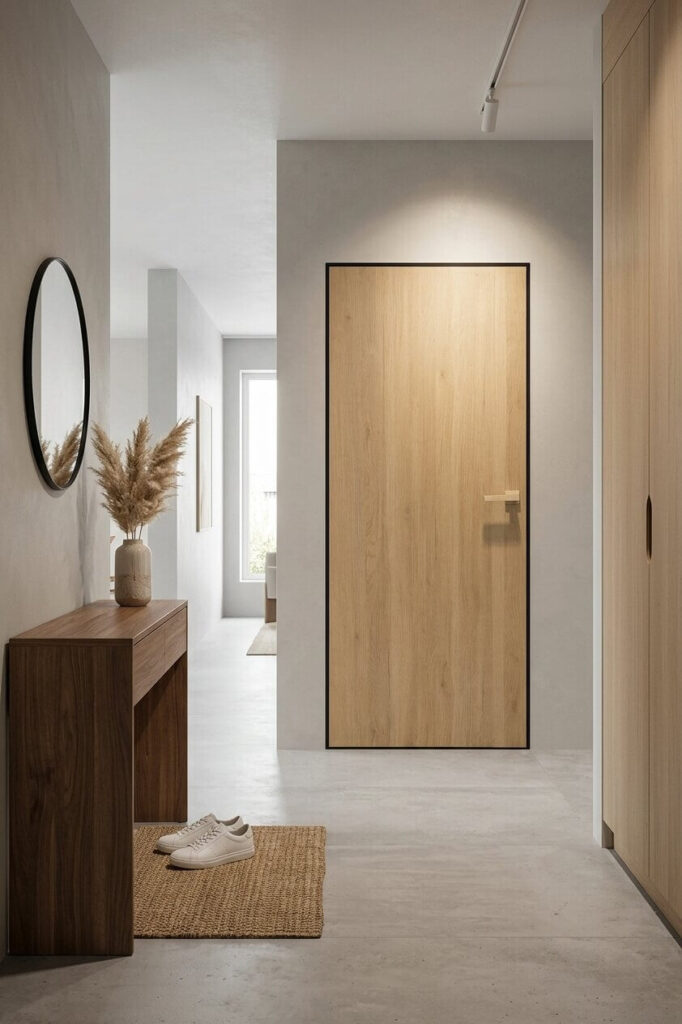
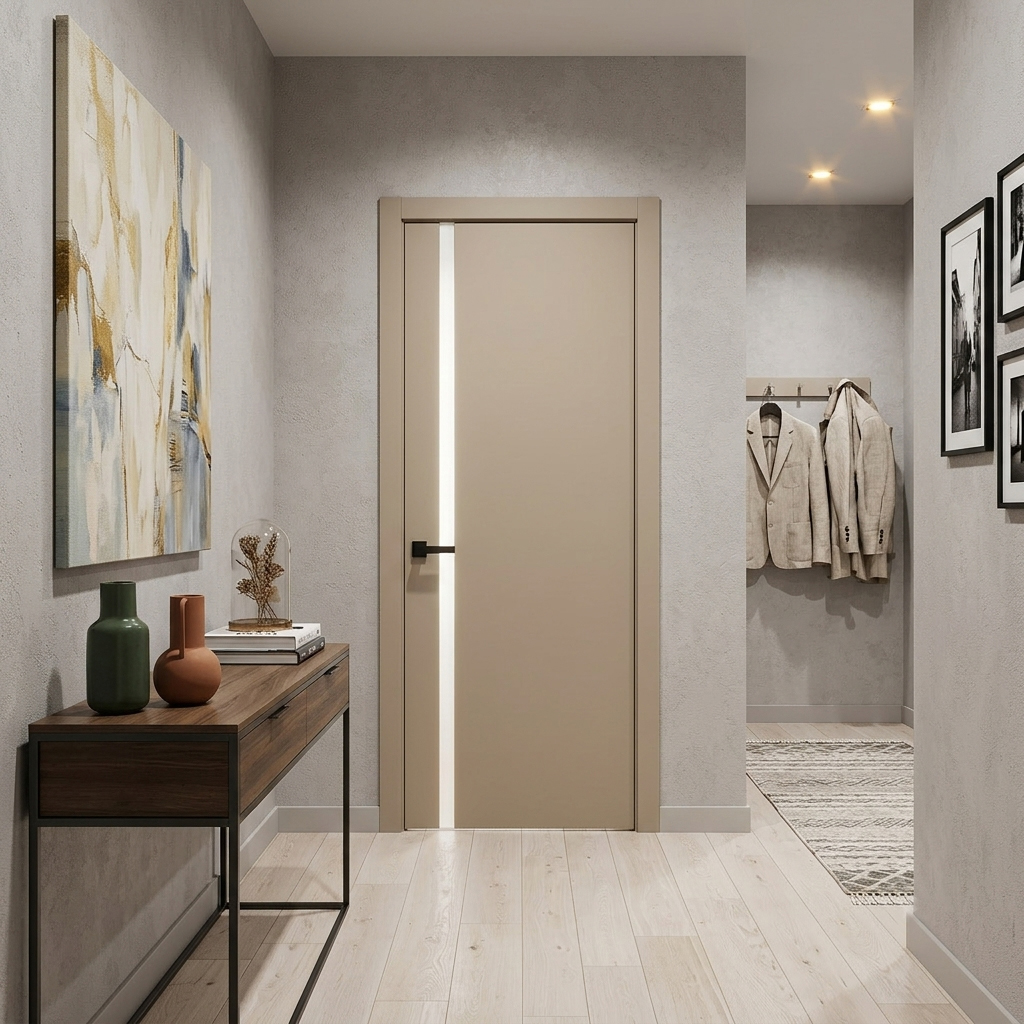
One feature people immediately notice is the flush construction. Instead of raised panels and decorative profiles, the surface remains flat. Perfectly flat.
Some homeowners initially worry this might feel cold. The opposite often happens. Without raised moldings competing for attention, natural wood grain becomes more noticeable. Wall textures become richer. Lighting creates softer shadows. Furniture becomes the visual focal point instead of every individual doorway.
It’s a little like removing background noise from a conversation. Suddenly everything important becomes easier to appreciate. Modern homes benefit especially from this approach. Large windows, open floor plans, continuous flooring, simple cabinetry. Flush doors fit naturally into these environments because they continue the same architectural language.
Nothing interrupts the flow.
Hidden Hinges Change More Than Appearance
Ask someone unfamiliar with European doors to identify what feels different. Many can’t. They simply say, “It looks better”. Concealed hinges play a surprisingly large role in creating that impression.
Traditional hinges remain visible whenever the door closes. There’s nothing wrong with that. They’ve worked successfully for generations. Concealed hinges disappear completely when the door shuts. No exposed metal, no hinge barrels, no screws. Nothing interrupting the surface.
It’s one of those details people rarely notice consciously. Yet remove visible hinges from an entire house and suddenly the walls feel calmer. Less busy. Architecture occasionally works through subtraction rather than addition.
Magnetic Locks Feel Different the First Time You Use One
Traditional door latches rely on angled metal pieces scraping across one another. Over and over, thousands of times. European magnetic locks function differently.
The latch remains hidden until it aligns with the strike plate. Then it snaps. No dragging, no metallic scraping. It’s a remarkably small innovation yet homeowners frequently mention it after living with European doors for only a few days.
Better Materials Lead to Better Performance
Construction quality isn’t always obvious from the outside. The inside tells the real story.
Many builder-grade American interior doors use hollow-core construction. They’re lightweight, affordable, and easy to transport. Also easy to install. For many projects, that makes perfect sense.
European interior doors frequently use engineered solid cores or dense composite materials. Immediately noticeable. Lift one. Open it. Close it. The added weight isn’t there simply to impress anyone — it contributes to stability, rigidity, acoustic performance, longevity. Doors experience thousands upon thousands of opening and closing cycles throughout their lives.
Construction quality quietly determines how gracefully they age.
Sound Reduction Is One of the Biggest Hidden Benefits
People shopping for doors often think about appearance first. Privacy arrives later — usually after moving in.
Solid-core European doors generally reduce sound transfer more effectively than lightweight hollow-core alternatives. That matters more than many homeowners expect. Bedrooms stay quieter. Home offices become more productive. Video meetings remain less distracting.Children sleeping upstairs aren’t awakened every time someone unloads groceries.
Silence has value. It’s difficult to photograph and easy to appreciate — especially after living with noisy doors.
European Doors Fit Modern Homes Exceptionally Well
Architecture evolves. Interior doors evolve with it.
Today’s homes frequently feature:
- Larger windows
- Open layouts
- Minimal kitchens
- Continuous flooring
- Hidden lighting
- Contemporary furniture
- Simple wall finishes
Traditional decorative panel doors don’t always complement these spaces naturally. European doors often do. They extend the architecture instead of competing against it. That’s an important distinction.
A door shouldn’t necessarily become the centerpiece of a room. Sometimes its greatest achievement is making everything around it look better. Rather generous, really.
They’re Available in More Finishes Than Most Buyers Expect
Minimal doesn’t mean limited. Far from it.
European manufacturers produce doors in an impressive variety of finishes. Natural oak, walnut, ash, paint-ready surfaces, ultra-matte lacquers, wood veneers, high-performance laminates, stone-inspired textures, concrete finishes, glass inserts, metal accents — the flat surfaces allow these materials to really shine.
Wood grain looks more authentic without decorative panels breaking it apart. Natural finishes feel natural. Imagine that.
European Doors Work in More Homes Than People Assume
Some homeowners believe European doors belong only inside ultra-modern mansions. That’s another myth. They certainly excel in contemporary architecture:
- Scandinavian interiors
- Transitional homes
- Luxury apartments
- Renovated lofts
- Warm contemporary spaces
- Minimal farmhouse designs
Even historic homes undergoing tasteful modern renovations. Simple architecture tends to adapt remarkably well. Heavy ornamentation usually has fewer places to hide.
Installation Is Different — And That’s a Good Thing
European doors require greater installation precision. That’s true. Flush alignment leaves less room for error. Concealed hinges demand accurate positioning. Integrated frames must remain perfectly square. Some people interpret this as a disadvantage — it’s better viewed as an investment in craftsmanship.
Premium hardwood flooring also requires skilled installation. Custom cabinetry does. Natural stone countertops certainly do. Nobody expects luxury materials to reward rushed workmanship. Doors deserve the same respect.
Once installed correctly, the results speak quietly for themselves. Very quietly. Usually with a magnetic click.
Why More American Homeowners Are Choosing European Doors
The American housing market has changed. Luxury construction has changed. Interior design has changed. Homeowners today spend far more time researching products than they did twenty years ago.
They travel more. They browse international architecture online. They notice design details in hotels and vacation homes. Eventually someone asks, “What kind of doors are those?” The answer increasingly leads back to Europe.
Not because European manufacturers invented doors. Obviously not. Because they invested decades refining modern interior door systems that align beautifully with contemporary architecture.
American buyers have simply started noticing. And once people experience concealed hinges, flush panels, integrated frames, magnetic locks, premium finishes, and solid construction together, going back feels surprisingly difficult.
Are European Interior Doors Worth It?
That’s the question hiding underneath every conversation. Price matters. Budgets matter. Every renovation has priorities. European doors generally cost more than builder-grade American alternatives. There’s no point pretending otherwise. The better comparison isn’t with the least expensive doors available — it’s with other premium architectural finishes.
Custom cabinetry. High-end flooring. Imported tile. Designer lighting. Those products aren’t evaluated solely by initial purchase price — they’re judged by how they improve daily living over years of ownership.
Interior doors deserve the same consideration. After all, you’ll probably touch them more often than your kitchen island. Certainly more often than your dining room chandelier. Quality becomes a daily experience rather than an occasional admiration.
Conclusion
So, what are European interior doors? They’re not merely flat doors with modern handles. They’re complete architectural systems engineered around precision, longevity, clean aesthetics, and exceptional everyday performance. They combine solid construction, integrated frames, concealed hinges, magnetic locks, premium finishes, and thoughtful engineering into one cohesive product instead of a collection of unrelated parts.
For American homeowners building custom homes, renovating older properties, or simply looking for something beyond conventional builder-grade options, European doors offer an entirely different experience. Not louder. Not flashier. Just better considered.
People rarely walk into a beautifully designed home and immediately announce, “Those are wonderful doors.” Instead, they say something else. “This house feels incredible.” That’s the magic. Great doors don’t usually demand attention. They quietly improve everything around them. And once you’ve lived with them for a while, you begin to understand that the question was never really “What are European interior doors”.
The better question is why we ever expected interior doors to be ordinary in the first place.