If you’ve been around enough remodels in California, you start noticing something unusual. Front doors used to be an afterthought. People obsessed over countertops, flooring, kitchen islands the size of small boats, and then picked a door in about seven minutes. Not anymore.
European door trends 2026 brings from across the Atlantic are changing that conversation in a pretty big way. Homeowners across Los Angeles, Orange County, San Diego, and even quieter suburban neighborhoods are paying attention to entrances that feel cleaner, smarter, and honestly more intentional.
It’s not about copying Europe. It’s about borrowing ideas that actually make sense for California living—better indoor-outdoor flow, modern materials that tolerate intense sun, cleaner architectural lines, and doors that become part of the home’s design instead of simply filling an opening in the wall.
Sometimes one piece of architecture suddenly becomes the thing everyone notices first. Let’s get into what’s going on.
Why California Is Looking Toward European Design
California architecture has always mixed influences from everywhere. Spanish, mid-century, Japanese minimalism, industrial lofts, modern coastal—you get the idea.
European manufacturers have quietly been refining residential doors for decades, focusing less on decoration and more on proportions, engineering, insulation, and subtle detailing. That philosophy happens to fit today’s California homes almost perfectly.
And here’s something contractors don’t always admit.
Many American entry doors still feel visually heavy. Thick trim. Raised panels. Decorative glass everywhere. Sometimes that’s exactly right for the house. Sometimes it looks like someone installed a castle gate on a minimalist home. A little awkward.
The latest European door trends 2026 brings over here lean toward balance rather than excess. Simple. Precise. Confident. No unnecessary ornament.
Bigger Doors Continue to Dominate
Bigger isn’t automatically better. Unless we’re talking about gold bars. Or tacos. But oversized entry doors? They’re definitely sticking around. Same about extra-wide pivot doors, large glass inserts, double-height entrances in custom homes, and wide interior passage doors that improve visual flow
A larger opening changes how a house feels before anyone notices finishes or furniture. The entrance breathes. That’s hard to measure on paper, but you absolutely notice it in person.
Minimal Frames Are Taking Over
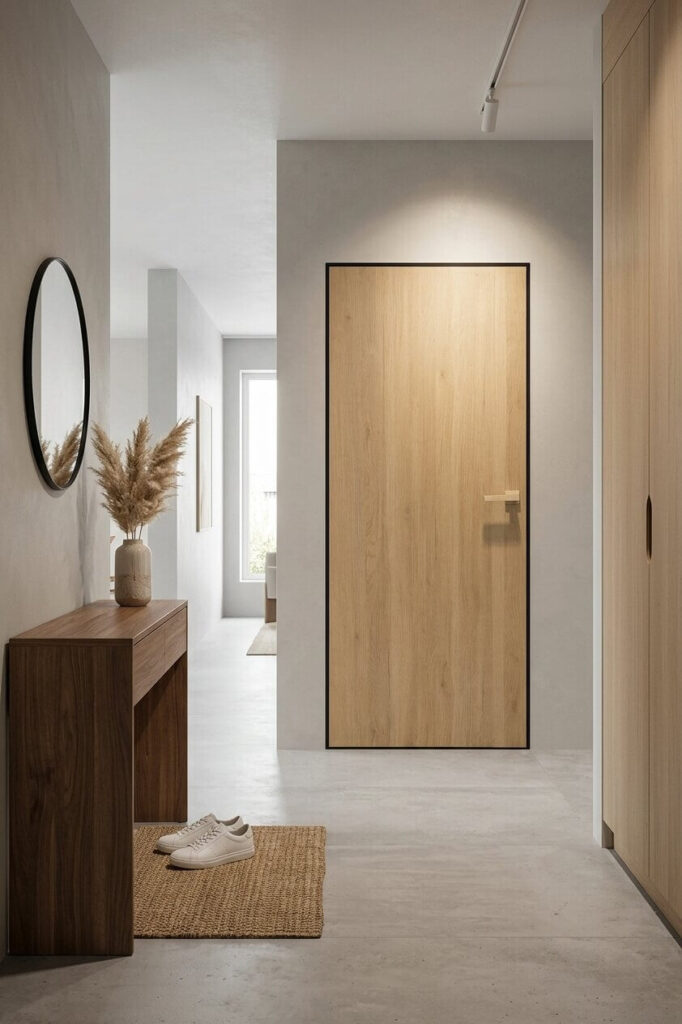
One of the strongest European door trends of 2026 is making frames almost disappear. Instead of thick decorative casings, designers are using flush wall systems, hidden jambs, slim aluminum frames, and concealed hinges. Making nearly invisible transitions between wall and door is the new black. It creates that floating appearance people associate with luxury European homes.
Most visitors won’t know exactly why the room feels cleaner. They just notice it feels expensive. That’s architecture doing its job.
Warm Woods Are Replacing Cool Gray Finishes
Gray had an incredible run. A very long run. Some neighborhoods practically turned fifty shades of gray overnight. Now? Not so much. Current European door trends bring warmth back through natural materials. Popular finishes include white oak, smoked oak, walnut, ash, light elm, and matte natural veneers. Not glossy. Definitely not orange. Just subtle wood grain with enough variation to remind people the material came from an actual tree.
California homeowners still love bright interiors, but they’re pairing white walls with warmer architectural details instead of colder ones. The result feels more comfortable without becoming rustic.
Matte Black Hardware Remains Strong
People keep asking if matte black is going away. Not yet.
The difference is that hardware is becoming more refined. Instead of oversized industrial handles, expect slimmer profiles inspired by European manufacturers: long vertical pulls, hidden locking systems, minimal rosettes, soft square edges, satin black finishes. Some luxury homes are even eliminating visible hardware from interior doors altogether.
Push. Click. Done. Simple things can be wonderfully satisfying sometimes.
Pivot Doors Continue Growing in Popularity
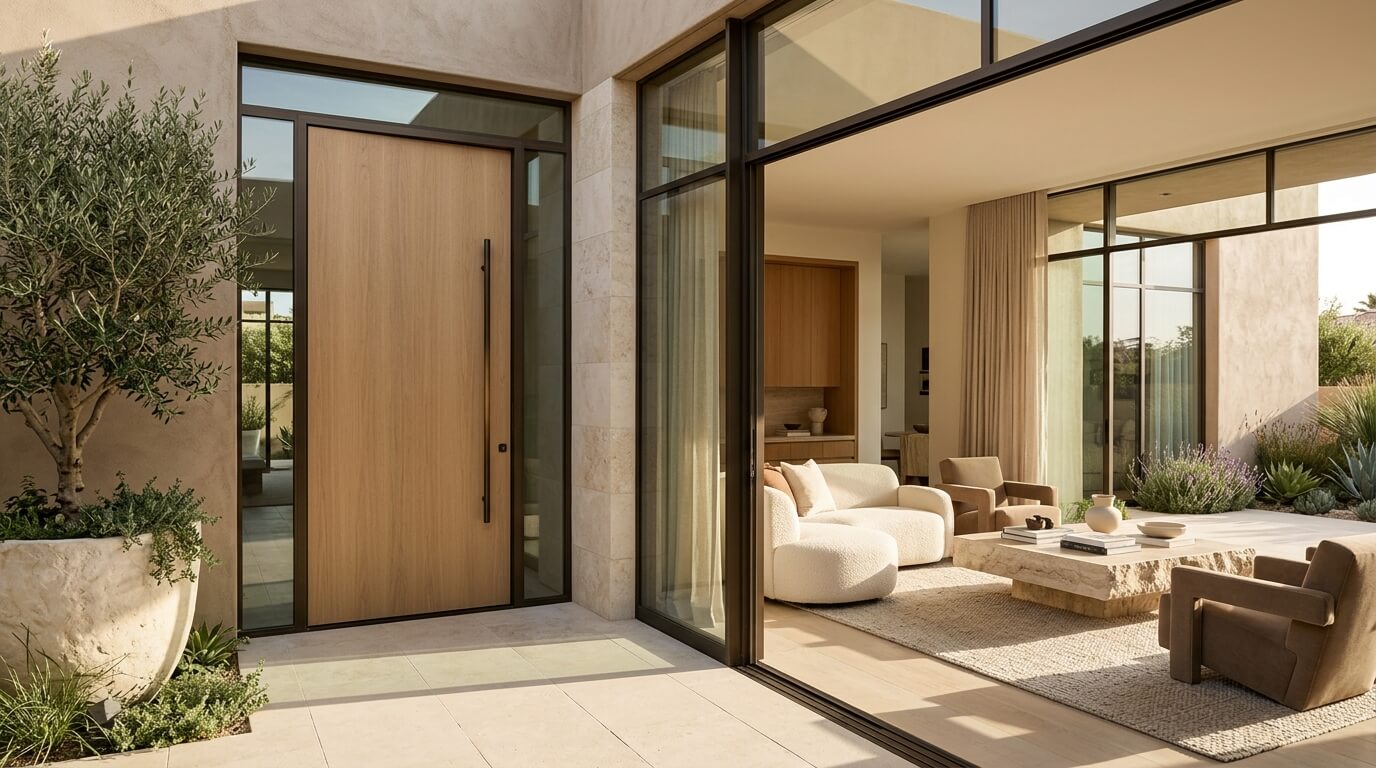
Pivot doors have become incredibly popular throughout Southern California. Why? Several reasons. First, they look amazing without relying on decoration. Second, they allow much larger panels than traditional hinges. Third, they simply operate differently.
Instead of swinging from the side edge, the pivot point sits inward from the frame. The movement feels smoother. Of course, proper engineering matters enormously here. Large pivot doors can weigh hundreds of pounds. The structure beneath them has to be designed correctly from day one.
Shortcuts create utter chaos in this case.
Glass Is Becoming More Architectural
Glass panels aren’t disappearing. They’re evolving. Instead of decorative bevels or busy patterns, homeowners increasingly choose narrow vertical glass strips, full-height frosted glass, textured privacy glass, bronze-tinted glazing, or low-reflective insulated glass.
The emphasis is on natural daylight while maintaining privacy. California sunlight is one of the state’s greatest assets. Makes sense to use it. Though maybe not during those August afternoons when everything feels like it’s melting.
Sustainability Is No Longer Optional
European manufacturers have emphasized sustainability for years. California buyers are catching up quickly. Modern doors increasingly feature FSC-certified wood, recycled aluminum, low-VOC finishes, better insulation cores, and energy-efficient glazing.
Durability itself has become part of sustainability. Replacing a cheap door every ten years isn’t exactly environmentally friendly. Installing one excellent door that lasts decades? Much smarter.
Flush Interior Doors Create Cleaner Spaces
Interior doors deserve more attention than they usually get. People spend months selecting cabinets. Then they install builder-grade hollow doors throughout the house. Bit of a missed opportunity.
Among the strongest European door trends are flush interior doors with hidden hinges, magnetic latches, minimal reveals, full-height designs, and continuous vertical lines. The walls appear smoother. Rooms connect more naturally. Visual clutter decreases.
It’s one of those upgrades that quietly improves every single day you live in the home.
Earth-Inspired Color Palettes
White will always have its place. So will black. But newer European-inspired homes are expanding beyond both. Trending finishes include: warm sand, clay, olive green, soft charcoal, deep bronze, muted terracotta. California landscapes influence many of these choices.
Walk through Malibu. Drive around Topanga. Spend an afternoon near Joshua Tree. Nature isn’t bright white—it’s layered. Those colors now appear in modern entry systems. Makes sense.
Smart Technology Becomes Nearly Invisible
Nobody wants their front door looking like a spaceship. That’s the direction manufacturers seem to understand. Instead of flashy gadgets, technology is disappearing into the design. Hidden fingerprint readers, mobile access, integrated cameras, smart locks concealed inside handles, remote monitoring—the best technology is almost invisible.
You notice the convenience. Not the electronics. Honestly, that’s how good engineering usually works.
Slim Aluminum Profiles Continue Expanding
Aluminum used to feel commercial. Office buildings. Storefronts. Airports. Now? Premium residential architecture has completely embraced it. Modern aluminum door systems offer thin profiles, exceptional rigidity, excellent corrosion resistance, large glass compatibility, and they also require minimal maintenance.
For coastal California, that’s especially attractive. Salt air is relentless. Beautiful beaches. Terrible for untreated metal.
Texture Is Quietly Making a Comeback
Not loud texture. Subtle texture. There’s a difference. Many European door trends 2026 brings include finishes with tactile qualities like brushed wood grain, stone-inspired laminates, linen-textured surfaces, soft matte coatings, and light vertical grooves.
These finishes create visual depth without relying on excessive decoration. It’s modern, but it doesn’t feel cold. That’s an important distinction.
Indoor-Outdoor Living Continues to Influence Design
California probably understands indoor-outdoor living better than almost anywhere else. European designers increasingly support that philosophy through larger openings and coordinated materials.
The transition between inside and outside becomes smoother. Less segmented, more connected. Even if everyone still ends up standing in the kitchen during parties.
Some things never change.
Security Is Becoming More Sophisticated
Here’s something that often gets overlooked. Modern European doors aren’t only attractive—they’re engineered. Multi-point locking systems continue gaining popularity because they secure the door at several locations simultaneously.
Benefits include better sealing, increased stability, improved resistance against forced entry, reduced air leakage, and longer hardware lifespan. Good security doesn’t have to look aggressive. Quiet confidence is much better.
Customization Without Excess
One interesting shift within European door trends is that customization doesn’t necessarily mean more decoration. Instead, homeowners customize through material combinations, handle selection, glass placement, finish colors, and panel proportions.
Small changes, big visual impact. That’s generally the smarter design approach. Adding five decorative elements rarely improves something. Choosing one perfect detail often does.
What California Homeowners Should Consider Before Choosing a European-Inspired Door
Trends come and go. The house stays.
So before selecting any modern door system, think beyond appearance. Consider your local climate. Sun exposure matters. Coastal moisture matters. Wildfire requirements matter in certain regions. Energy performance matters more than many people realize, especially with California’s changing efficiency standards.
Also, installation quality is everything. Seriously.
You can purchase the finest European-designed door available, but poor installation can create alignment problems, water intrusion, drafts, hardware wear, and premature failure. We’ve seen projects where a spectacular $12,000 entry system was compromised by rushed framing. Painful.
The installer matters almost as much as the manufacturer. Maybe more.
Looking Ahead
The biggest takeaway from European door trends 2026 brings isn’t a particular color or hardware finish. It’s a philosophy.
Modern homes are moving toward cleaner lines, better engineering, improved sustainability, and thoughtful simplicity instead of unnecessary ornament. California happens to be an ideal place for that evolution. The climate encourages larger openings. The architecture welcomes minimalism.
Homeowners increasingly appreciate products that combine beauty with long-term performance. And honestly? That’s a good direction.
A front door should feel solid every time you close it. It should keep your home comfortable, secure, and efficient while looking like it genuinely belongs there—not like it was picked from the last page of a catalog because the project was running behind schedule. Small detail? Maybe. Except it isn’t.
It’s the first thing people see, the last thing they touch before leaving, and one of the few architectural elements that every visitor experiences. That’s a lot of responsibility for a single door.