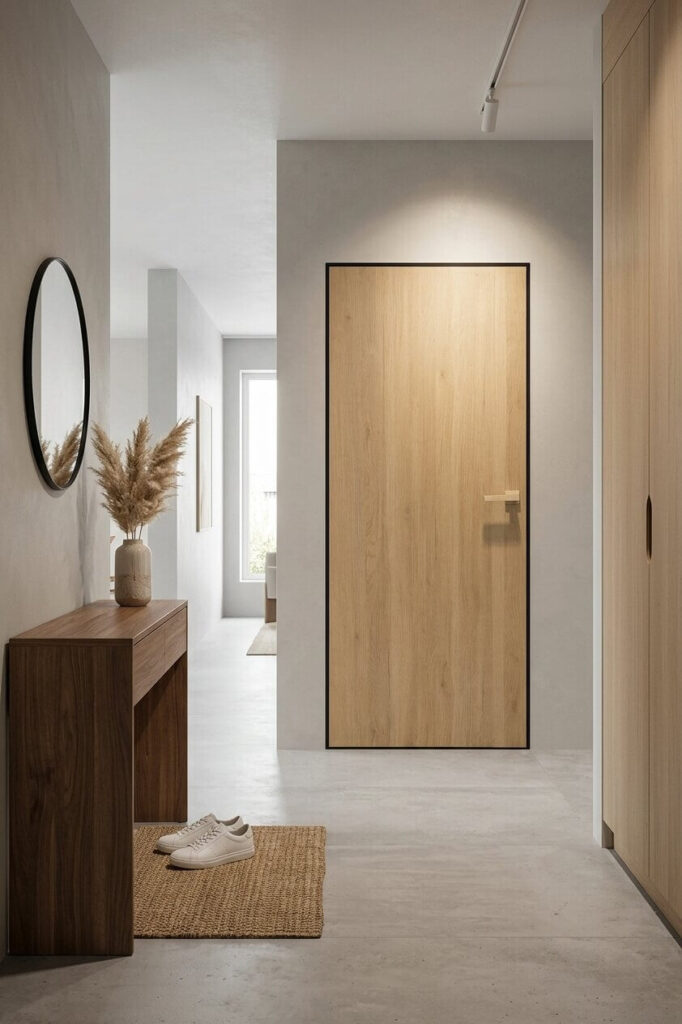
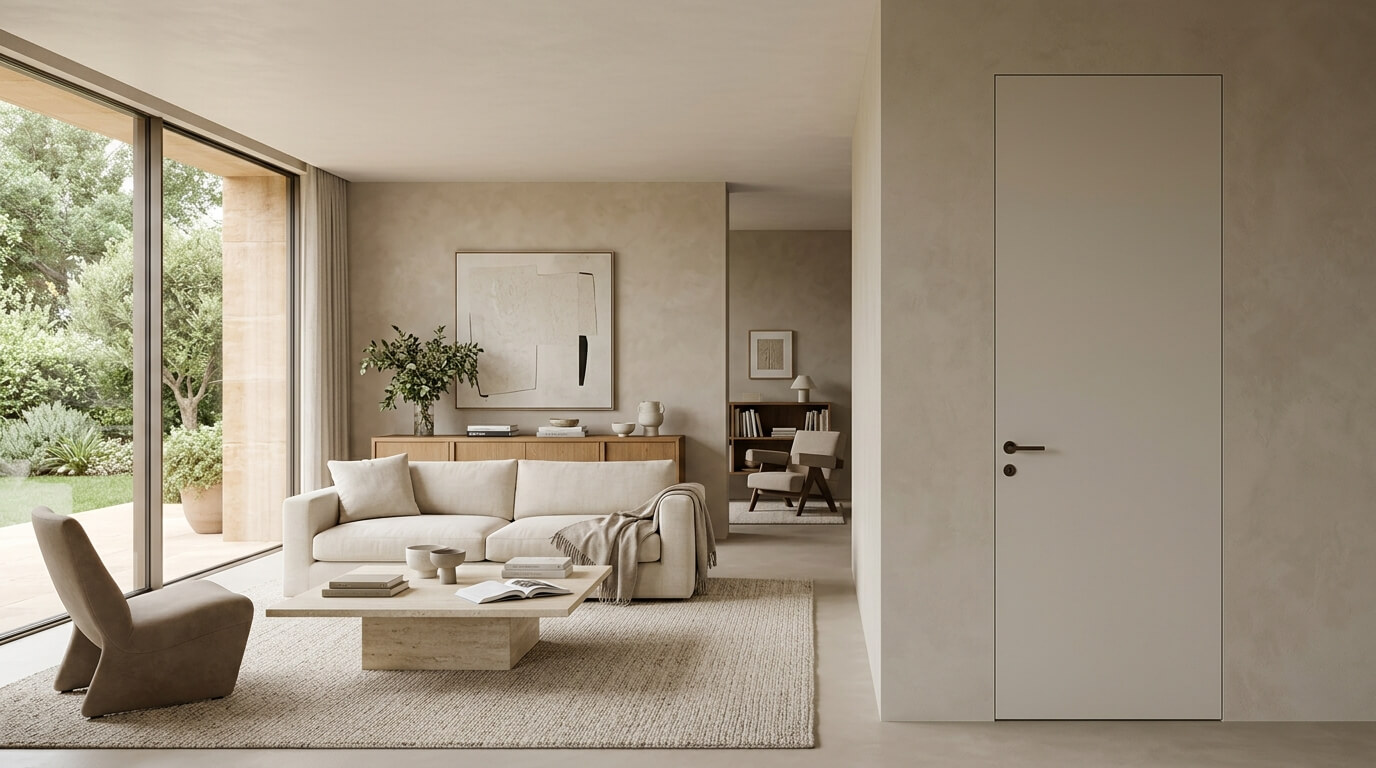
There’s that moment that happens in truly wonderful homes. You walk inside. You stop. Not because of one spectacular feature, but because something feels unusually calm. Your eyes keep moving without bumping into anything. The walls stretch farther than they probably should. The light wanders around like it forgot where it was going. Then, eventually, you notice what’s missing.
The doors aren’t asking for attention. That’s the trick.
The best minimalist interior doors don’t perform—they participate. Like a bassist in a great band: you don’t always hear them separately, yet remove them and the whole song suddenly collapses into awkward nonsense.
For years people treated interior doors like punctuation marks. Necessary pauses between rooms. Open. Close. Repeat. Now they’re becoming part of the sentence itself, and somehow the sentence reads more smoothly because fewer words are trying to impress you.
Luxury Has Learned to Whisper
Luxury used to enjoy making announcements. Large moldings. Carved panels. Gloss everywhere. If a surface wasn’t decorated, somebody apparently felt obligated to decorate it before lunch.
Things shifted. Not overnight, obviously. Buildings don’t usually wake up with new personalities. But somewhere along the way designers realized that expensive doesn’t necessarily mean elaborate. Sometimes it means removing everything that doesn’t absolutely deserve to survive.
That’s where minimalist interior doors quietly stepped into the conversation. Or maybe stepped out of it. Instead of becoming decorative objects, they dissolve into the architecture until the entire room feels calmer. Cleaner. More confident. Confidence rarely needs fireworks anyway.
The Eye Likes a Clear Path
We think we’re simply looking at rooms, but our minds are constantly negotiating thousands of tiny visual decisions. Raised panels. Decorative trim. Sharp shadows. Heavy casings. Every little interruption demands a microscopic piece of attention.
Not enough to notice consciously. Enough to matter. When those interruptions disappear, the room starts breathing differently.
Minimalist interior doors allow your eyes to travel almost uninterrupted across walls, through openings, toward windows flooded with California sunlight that occasionally behaves like it owns the place. The architecture stops arguing with itself and that’s surprisingly relaxing.
Flat Surfaces Aren’t Empty
People sometimes hear the word “minimalist” and imagine sterile white boxes where nobody laughs and every chair costs more than a new TV. That’s not really the point.
A flush door isn’t blank because the designer forgot to finish it. It’s blank because every unnecessary detail was questioned until only the important ones remained. That takes restraint, which is oddly more difficult than adding decoration.
Anyone can keep adding. Removing? That’s uncomfortable. The clean surface of a minimalist door creates room for everything around it to become more expressive. Wood flooring suddenly feels richer. Natural stone gains depth. Textiles become softer somehow. The architecture isn’t competing anymore. It’s listening.
Hidden Frames Feel Like Quiet Magic
There are details homeowners rarely ask for because they don’t know they exist. Hidden frames belong firmly in that category.
Traditional trim announces every doorway with thick borders. Hidden systems do the opposite. They erase themselves until the wall and the door appear to have reached some private agreement. The result feels almost impossible the first time you notice it.
Actually, that’s not accurate. The first time you don’t notice it. That’s better.
Minimalist interior doors with concealed frames make walls feel uninterrupted in a way that’s difficult to explain without physically standing in the room. Photographs help. Reality does a better job. Construction is full of expensive ways to make things disappear.
Height Changes Everything
There are upgrades that impress people immediately. Then there are upgrades that quietly change how an entire home feels without anyone understanding exactly why.
Full-height doors belong to the second group.
Extending minimalist interior doors toward the ceiling stretches the room visually. The proportions shift. Vertical lines become stronger. Even average ceilings suddenly seem more ambitious.
No walls moved. Nothing magical happened. Sometimes good architecture feels suspiciously close to magic, though.
Warmth Doesn’t Need Decoration
Minimalism gets accused of being cold. Often by rooms painted entirely gray. That’s not minimalism’s fault.
Warmth has always come from materials rather than ornament. Natural oak. Walnut with subtle movement across the grain. Soft matte finishes that invite your hand before your eyes fully understand why. Light that changes throughout the afternoon and quietly repaints the walls without charging extra.
Minimalist interior doors benefit from this philosophy because they don’t hide the character of honest materials behind excessive styling. Wood already knows how to be beautiful. People occasionally interrupt.
Hardware Is Learning Some Manners
Door handles used to make speeches. Heavy brass. Decorative curves. Giant backplates that seemed determined to introduce themselves before the door did.
Modern hardware has become polite.
Slim profiles. Hidden hinges. Magnetic latches that close with a gentle confidence instead of a dramatic clunk worthy of a detective movie from 1978. The mechanics remain sophisticated, but visually they step aside and let the architecture continue talking.
Machines don’t always need to look like machines.
Light Behaves Differently Than We Remember
Sunlight is wonderfully stubborn. It doesn’t care about trends. It doesn’t care about Pinterest boards. It simply enters the house and starts bouncing off whatever surfaces happen to exist.
Flat surfaces reflect it differently. Hidden frames reduce unnecessary shadows. Continuous walls guide it farther into the interior, where it softens corners and quietly changes mood every hour or so. California homes understand this especially well because daylight arrives generously, occasionally almost too generously. August afternoons can feel like somebody turned the brightness slider too far.
Still worth it.
The cleaner geometry surrounding minimalist interior doors allows natural light to become one of the home’s primary design materials. Without installing anything new.
Open Spaces Need Quiet Architecture
Open floor plans sound easy until you actually have one. Suddenly every decision affects everything else. The kitchen talks to the living room. The dining area overhears the conversation. Hallways refuse to stay out of it. Consistency becomes incredibly important.
Using minimalist doors throughout the home creates visual continuity without becoming repetitive. That’s a delicate balance. Too much variation feels chaotic. Too much uniformity becomes oddly lifeless, like someone alphabetized the clouds.
Architecture lives somewhere between those extremes.
Silence Has Become a Luxury
Something changed after more people began working from home. Quiet gained value. Real value.
A beautiful office doesn’t help much if every phone call competes with kitchen conversations and someone practicing the same three guitar chords for six consecutive months. We’ve all known that neighbor. Or been that neighbor.
Premium minimalist interior doors often combine understated aesthetics with substantial solid-core construction, allowing spaces to feel visually connected while remaining acoustically separated.
Engineering doesn’t always announce itself. Exactly as intended.
Individuality Doesn’t Need Ornament
Luxury homes still reflect the personalities of the people living inside them. That hasn’t changed. What has changed is the language designers use to express individuality.
Instead of carving decorative patterns into every available surface, they explore proportions, subtle material changes, carefully selected finishes, and tiny details that reveal themselves slowly rather than immediately. Like conversations that improve after the first five minutes.
Minimalist interior doors fit beautifully within that philosophy because they leave room for interpretation. Not everything has to explain itself instantly.
Precision Becomes Visible
Minimalist architecture is unforgiving. A decorative casing can politely hide small framing mistakes. A heavily detailed door can distract your attention from tiny alignment issues. Flush systems? They simply refuse to participate in that cover-up.
Every reveal matters. Every shadow line matters. Every adjustment matters. Installing minimalist doors requires patience bordering on obsession, because once everything unnecessary disappears, precision becomes impossible to fake.
Why They Keep Returning
Design trends usually arrive with noise. Then they leave the same way.
Minimalist interior doors have followed a different path. They’ve stayed because they solve problems instead of creating them. They simplify interiors without making them empty. They allow expensive materials to remain the stars of the room. They age without constantly reminding homeowners what year they were installed.
Maybe that’s why they continue showing up in homes that feel timeless rather than fashionable. Or maybe people are simply getting tired of visual clutter. Hard to blame them. The world outside already provides plenty of that. Inside the house, it turns out a quiet wall, a perfectly aligned doorway, and a door that almost disappears can feel oddly reassuring. Like finding an empty stretch of beach in Malibu on a weekday morning. You know it won’t stay empty forever, but for a little while it belongs only to the light, the breeze, and the wonderfully unnecessary silence between one room and the next.