
The San Diego Climate Problem Nobody Talks About
If you’ve lived in San Diego or Orange County for more than a year, you already know winter here doesn’t look like winter anywhere else. There’s no frost, no snow, no freezing pipes to worry about. But that doesn’t mean your interior doors are immune to seasonal stress – they’re just dealing with a very different kind of climate challenge, and it’s one most homeowners never think to prepare for: Santa Ana wind season.
From roughly September through May, San Diego and Orange County experience periodic Santa Ana wind events – hot, fast-moving air that flows from the inland deserts toward the coast. These winds don’t just make for smoky-orange sunsets and elevated wildfire risk. They also cause relative humidity to plummet dramatically, sometimes dropping below 10% for days at a time – a level of dryness most homeowners never associate with coastal Southern California.
That rapid, repeated swing between normal coastal humidity and near-desert dryness is exactly the kind of condition that stresses wood, causes doors to shrink and crack, and leads to the sticking, gapping, and squeaking that homeowners often assume is just “old house” wear and tear. Add in San Diego’s coastal marine layer on the other end of the spectrum – a salt-laden, humid air mass that rolls in along the coast, particularly in neighborhoods west of the I-5 – and interior doors here are actually working through more seasonal stress than most homeowners realize.
Here’s how to protect them.
1. Give Your Doors a Proper Seasonal Cleaning
Before Santa Ana season ramps up in the fall, it’s worth giving every interior door a real once-over – not just a quick wipe. Santa Ana events carry fine dust and particulate matter that settles into hinges, tracks, and door edges, and that buildup accelerates wear if it’s left alone.
- Use a soft microfiber cloth to remove dust from door surfaces, tops, and edges – areas that collect more debris than people expect.
- For fingerprints, smudges, or built-up grime near handles, a mild soap-and-water solution works well on most factory finishes.
- Pay particular attention to sliding door tracks and frameless door edges, where dust accumulation can affect smooth operation over time.
Clean doors aren’t just about appearance – a door free of grit in its tracks and hinges operates more smoothly and experiences less mechanical wear over the season.
2. Manage the Humidity Swings, Not Just the Dryness
Most conventional door-care advice focuses on dealing with dry winter heating air – a real issue in colder climates, but not really San Diego’s problem. Here, the challenge is more specific: repeated, sometimes rapid swings between the extreme dryness of Santa Ana events and the higher humidity of a normal coastal day, or the salt-laden moisture of the marine layer in coastal neighborhoods.
Wood – even well-engineered, multi-layer European door construction – responds to these swings by expanding and contracting slightly over time. Left unmanaged across enough cycles, this is what causes a door that used to close perfectly to start sticking at the top corner, or leave a visible gap at the bottom.
A few practical steps help:
- Use a humidifier during extended Santa Ana events, particularly in rooms with doors that seem sensitive to humidity swings. Bringing indoor air back toward a moderate humidity level reduces the stress on wood doors and trim.
- Don’t over-correct with excessive indoor humidity either – especially in homes closer to the coast, where the marine layer already adds ambient moisture. The goal is stability, not maximum humidity.
- If a door starts sticking or dragging, address it early. A small adjustment – a slight hinge shim, a minor plane on a binding edge – prevents the kind of repeated forcing that leads to more serious wear over a season.
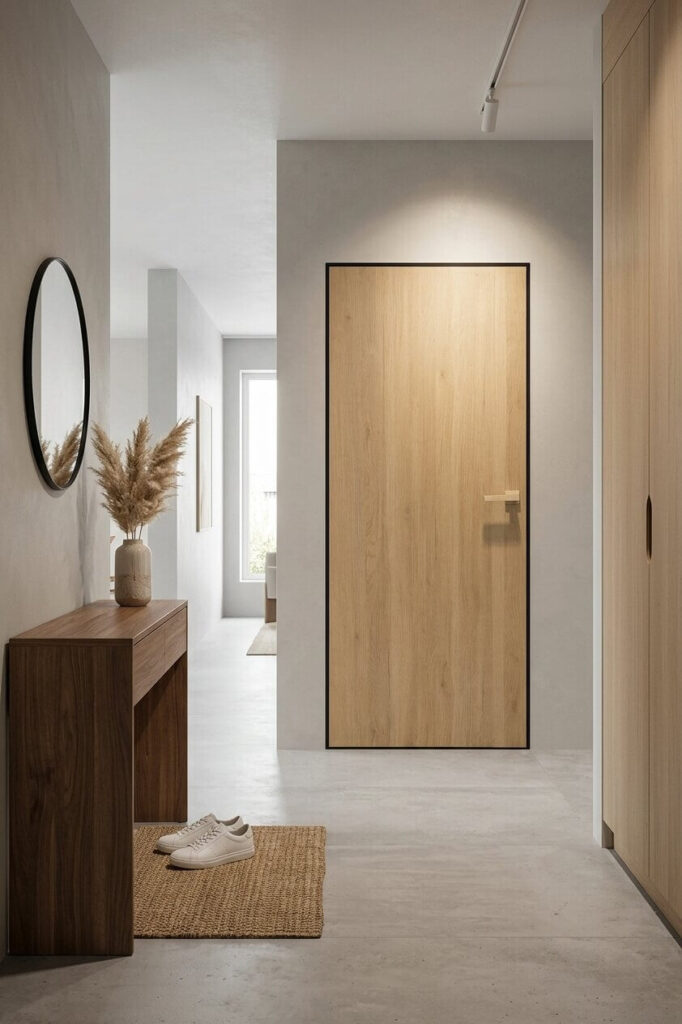
This is also where the quality of the door itself matters. Diana Doors’ European-engineered doors are built with multi-layer construction specifically for dimensional stability – meaning they resist the expansion and contraction that causes cheaper, single-layer doors to warp, crack, or stick after a few Santa Ana seasons.
3. Keep Hinges and Hardware Moving Smoothly
Dry, dusty air doesn’t just affect the door slab – it affects hinges and hardware too. Fine particulate matter carried in on Santa Ana winds can work its way into hinge mechanisms, and combined with the dryness itself, this is often what causes doors to start squeaking during wind season specifically, even when they were silent all summer.
- A few drops of a silicone-based lubricant on hinge pins, applied with a gentle swing of the door to work it in, resolves most seasonal squeaking quickly.
- Check visible hardware – handles, hinges, sliding door tracks – for any dust buildup that could affect smooth operation, particularly after a multi-day wind event.
- For sliding door systems, tracks deserve special attention, since dust accumulation here affects both sound and smoothness of operation more noticeably than on a standard hinged door.
Well-engineered hardware – hidden hinges, magnetic locking systems, precision-aligned tracks – tends to hold up better through these seasonal cycles than basic builder-grade hardware, which is one more reason quality manufacturing pays off over years of ownership, not just on installation day.
4. Handle Doors a Little More Gently During Peak Wind Events
There’s a less obvious effect of Santa Ana wind season worth knowing about: pressure differentials. When strong winds are blowing and windows or other doors in a home are open, interior doors can slam shut with real force – enough, over repeated events, to stress hinges and door frames faster than normal daily use would.
A few simple habits reduce this wear:
- Keep interior doors closed (rather than propped open) during active wind events, since a closed door isn’t subject to being caught and slammed by a sudden gust elsewhere in the home.
- Consider soft-close mechanisms on frequently used doors – a practical upgrade that reduces slamming-related wear year-round, not just during wind season, while adding a noticeably more refined, quiet feel to daily use.
- If you notice a door has developed a new gap, squeak, or stiffness after a particularly strong wind event, it’s worth a quick check rather than waiting – small adjustments now prevent bigger repairs later.
Why This Matters More Than Most Homeowners Realize
It’s easy to assume interior doors are a “set it and forget it” element of a home. In most of the country, that’s roughly true. But San Diego and Orange County’s specific climate pattern – hot, bone-dry Santa Ana events cycling against a cooler, humid coastal baseline, sometimes within the same week – puts real, recurring stress on interior doors that homeowners in more climate-stable regions simply don’t deal with.
Over years, this is exactly the kind of seasonal cycling that separates well-engineered doors from builder-grade ones. A hollow-core, single-layer door has little structural resistance to repeated expansion and contraction, and it shows – warping, sticking, visible gapping – often faster than homeowners expect. A properly engineered, multi-layer European door is built specifically to resist this kind of seasonal movement, which is part of why the upfront investment tends to pay off well beyond the first year.
When Seasonal Wear Signals It’s Time for an Upgrade
A little seasonal maintenance goes a long way, but it’s worth recognizing when a door’s issues have moved beyond routine care:
- Persistent sticking or dragging that returns even after adjustment
- Visible warping, cracking, or splitting along panel seams
- Hardware that no longer aligns properly no matter how it’s adjusted
- Finish that’s visibly worn, faded, or cracked from repeated humidity cycling
If any of that sounds familiar, it’s usually a sign the door itself – not just the hardware – has reached the end of what maintenance can fix. At that point, replacing it with a properly engineered, custom-fitted door is typically more cost-effective than continuing to patch a door that’s fighting the climate every season.
Ready for Doors That Handle San Diego’s Climate Without the Upkeep?
Diana Doors designs and installs European-engineered interior doors built for real Southern California conditions – from Santa Ana dryness to coastal humidity – across San Diego and Orange County, including Irvine, Chula Vista, El Cajon, and La Mesa. Schedule a consultation to see how a properly engineered door can mean far less seasonal maintenance, year after year.