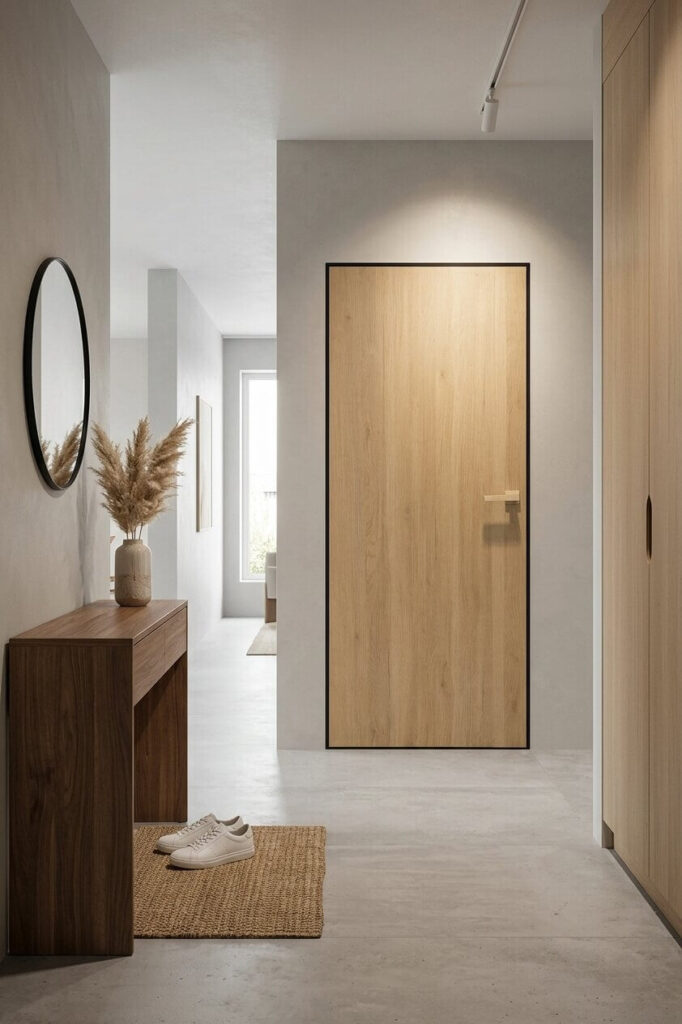
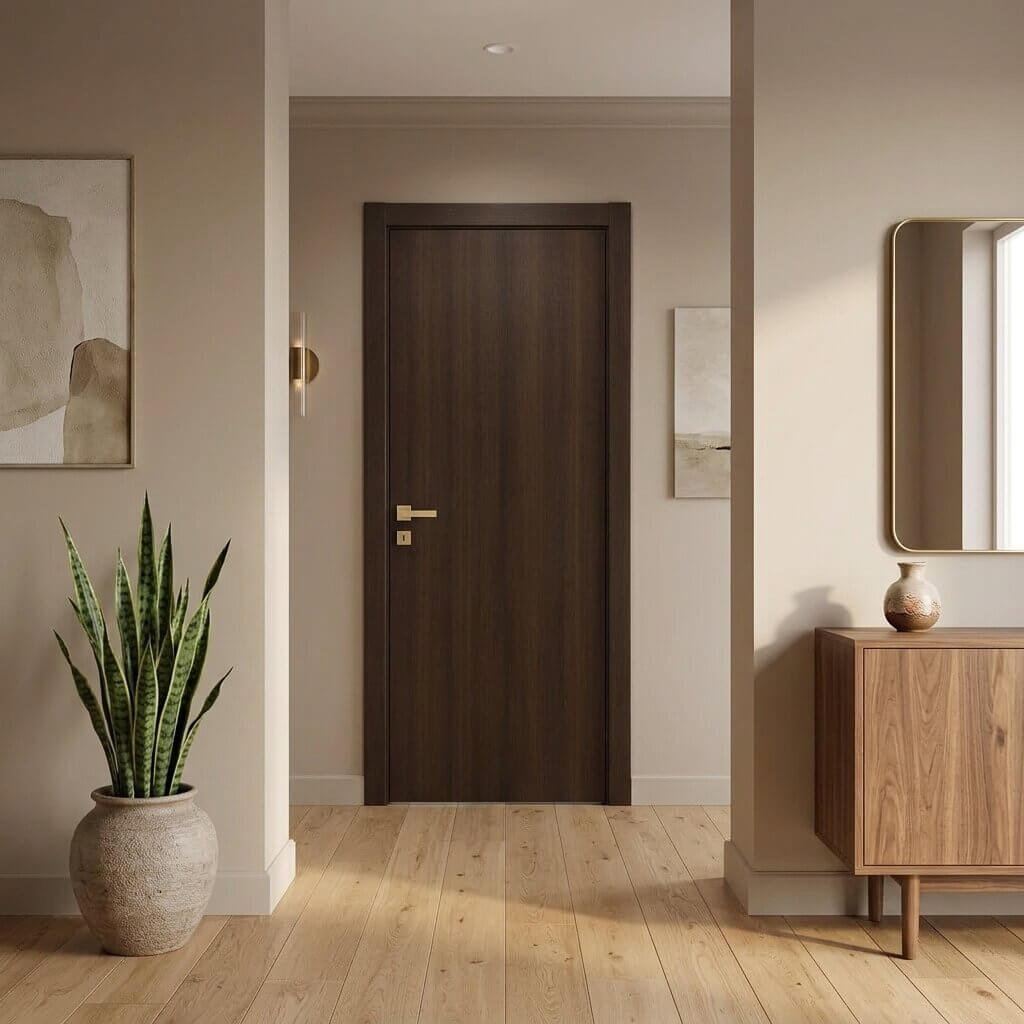
People talk about kitchens first. Always kitchens. Quartz countertops, waterfall islands, fancy faucets that look like they belong in Buckingham Palace. Then the conversation wanders toward bathrooms, flooring, oversized windows, maybe a wine cellar if everyone is feeling ambitious.
Interior doors? Almost never.
Which is strange. Really strange, actually. You probably touch an interior door more often than your kitchen countertop. Bedroom. Bathroom. Closet. Office. Laundry room. Repeat tomorrow. And the day after that. Yet most people spend weeks comparing backsplash tile while accepting whatever doors came with the builder package.
Then something happens.
You visit a wonderfully designed house somewhere in La Jolla. Maybe Del Mar. Rancho Santa Fe. Doesn’t matter much. You walk through the hallway and immediately notice something. The rooms feel quieter. Cleaner somehow. Less visually busy. The doors close with this soft, confident little sound. Not loud, just reassuring. Like shutting the door on a luxury German sedan.
You’ll simply think the house feels expensive. That’s the trick. The best design rarely waves its arms around demanding applause. It just quietly raises the standard until ordinary things begin feeling oddly disappointing.
That’s one reason homeowners searching “luxury interior doors San Diego” online have started looking beyond traditional American options. They’re no longer shopping for rectangles that separate rooms. They’re paying attention to craftsmanship. Materials. Hardware. Proportions. Tiny engineering decisions that nobody notices individually but everyone somehow feels.
What Actually Makes a Door “Luxury”
“Luxury” gets tossed around with astonishing confidence these days.
Luxury vinyl flooring, luxury candles, luxury dog beds, luxury bottled water. At some point the word starts looking suspicious. Let’s rescue it.
When we talk about luxury interior doors, we’re not talking about excessive decoration or ornate carvings that belong in a medieval castle. Real luxury tends to whisper. It has better manners than that.
It hides inside precision. Inside restraint. Inside details so small they’re almost rude about refusing attention.
The First Thing You Notice Isn’t What You Think
People assume they’ll notice appearance first. Sometimes they do. More often? They notice the feeling.
The door swings differently. It doesn’t wobble halfway through its arc like it’s reconsidering life choices, it glides. Then closes. Click. Done. No rattle. No awkward bounce. No second attempt because the latch decided today wasn’t a good day for cooperation.
Odd how satisfying that becomes.
Weight Tells Stories
Here’s a strange experiment. Close your eyes and touch two different interior doors: one is hollow-core, another is a premium European solid-core model. You won’t need labels. Your hands figure it out almost immediately.
Weight communicates quality long before your brain starts analyzing construction methods. Humans have always done this. Pick up a cast-iron skillet, then pick up a disposable aluminum pan, and your expectations change before you’ve cooked a single egg.
Doors aren’t all that different.
Tiny Gaps, Big Consequences.
There’s something quietly unsettling about uneven door reveals. Most homeowners can’t explain why, they simply sense something feels off.
A wider gap on one side. A slightly crooked line near the top. Nothing special, just enough visual static that your brain keeps trying to straighten it out without asking permission.
Premium European manufacturing chases consistency almost obsessively. Equal spacing. Straight lines. Balanced proportions. Architecture suddenly exhales. Not because anyone consciously measured anything, but because your eyes finally get to rest.
Average Doors Aren’t Bad.
They’re just built for different conversations. Let’s be fair—builder-grade doors exist for a reason. Entire housing developments need thousands of them. Budgets matter. Construction schedules matter. Availability matters. Developers aren’t necessarily choosing the worst doors—they’re choosing doors that make sense for large-scale construction.
Those aren’t always the same thing.
Homeowners renovating one house have a completely different conversation. They’ll open these doors tens of thousands of times. Possibly hundreds of thousands.
That’s quite a relationship. Might as well choose carefully.
Hollow Core Has Its Place
People occasionally hear “hollow core” and assume disaster. Not quite.
Hollow-core doors are affordable, lightweight, easy to install, and also are perfectly functional until someone starts practicing trumpet in the guest bedroom. Or your teenager discovers electric guitar. Or your home office suddenly shares a wall with a family movie night.
Sound travels, remarkably well.
Solid-core European doors don’t eliminate noise entirely. Life would be wonderfully simple if they did, but they noticeably soften it. Bedrooms become quieter. Home offices become more useful. Bathrooms become, well, more private.
Everyone wins.
Time Is Surprisingly Honest
Some products age gracefully. Leather, cast iron, hardwood floors. Others, not so much.
Interior doors live complicated lives: humidity changes, air conditioning cycles, children slam them, dogs scratch them, furniture bumps into them.
Average construction eventually starts showing its homework. Premium engineering simply keeps going. A little boring, perhaps. Dependability often is, though.
The Hardware Isn’t Just Decoration
There’s a temptation to treat hardware as jewelry. Pick something shiny, move on. Actually, hinges and magnetic latches behave more like joints in the human body. Nobody thinks about knees while they’re working properly. The moment something clicks is a different story entirely.
Premium luxury interior doors rely on premium hardware because beautiful wood attached to mediocre hinges eventually becomes, well, beautiful wood that squeaks.
Why European Doors Changed So Many Expectations
European designers have always had an interesting relationship with restraint. Walk through homes in Italy, or Germany, or Scandinavia and you’ll notice something: the architecture rarely competes with itself, walls remain calm and doors disappear into them. Everything feels intentional without becoming sterile.
That’s harder than it sounds. Minimalism done poorly feels cold. Done well? It feels peaceful. Like someone tidied your thoughts without asking.
Flush Doors Change Entire Rooms
Panel doors tell stories. Flush doors tell silence.
Without raised panels interrupting every surface, walls begin reading as complete architectural planes. Natural light slides differently across them. Hallways seem longer. Ceilings occasionally appear higher.
Optical illusion? Partly. Good design enjoys borrowing a few tricks from psychology.
Hidden Hinges Are Slightly Addictive
Nobody walks into a showroom asking, “Where are your hidden hinges?” Then they see them. And suddenly traditional hinges look strangely busy. Not wrong, just louder.
Hidden hardware removes another tiny distraction from the room. One less visual interruption. Multiply enough tiny improvements together and entire homes begin feeling calmer.
Magnetic Latches Are Quietly Brilliant
Traditional latches have personalities. Sometimes enthusiastic personalities. Metal clicks, little vibrations, tiny rattles. Magnetic latches approach the job differently.
They don’t announce success. They simply complete it. Softly.
Why Luxury Interior Doors Belong in San Diego Homes
San Diego has this interesting architectural confidence.
Mediterranean villas sit a few streets away from minimalist coastal homes. Spanish Revival neighbors contemporary cubes made almost entirely of glass. Somehow it all works.
Good climate helps, so does sunlight. Lots of sunlight. European doors fit surprisingly comfortably into that landscape because they don’t demand attention from it. They cooperate.
Indoor and Outdoor Start Blending Together
One thing Southern California understands exceptionally well is borrowed space. Patios become living rooms. Courtyards become dining rooms. Sliding walls disappear.
Interior architecture suddenly matters more because you’re constantly moving between environments. Heavy visual clutter interrupts that flow. Minimalist European doors keep it moving. Quietly.
Expensive Kitchens Deserve Better Neighbors
Here’s an oddly common kind of renovation. Spending $120,000 remodeling a kitchen, installing imported stone, designer lighting, custom cabinetry, and professional appliances—then leaving the original hollow-core interior doors.
It’s a bit like wearing an expensive tuxedo with a bright green Dallas Stars cap. Technically possible, emotionally confusing.
Premium doors finish the sentence right.
Buyers Notice More Than They Admit
Real estate agents see this constantly. Potential buyers rarely say, “The hidden hinges influenced our offer.” Instead they use broader language.
“This house feels custom.” “It feels finished.” “It feels expensive.” Those impressions don’t appear by accident, they’re assembled. One decision at a time.
Why Diana Doors Thinks Differently
At Diana Doors, selling doors has never been the interesting part. Helping homeowners rethink what interior architecture can feel like? Now we’re getting somewhere.
We specialize in luxury interior doors San Diego homes and apartments really deserve because we genuinely believe the difference becomes part of everyday life—not just renovation photographs.
Showrooms Exist for a Reason
Online pictures are useful. Until they aren’t. You can’t feel a magnetic latch through a laptop. You can’t understand solid-core construction from a thumbnail image. You certainly can’t appreciate premium finishes by zooming in.
Doors deserve a touch.
Guidance Beats Guessing
Most people renovate a kitchen once. Maybe twice. Interior doors? Often once in a lifetime.
Questions aren’t just expected. They’re healthy. Frame systems, hidden hinges, flush installation, wood veneers, painted finishes—different homes deserve different solutions.
Our job is translating engineering into plain English.
Quality Ages Quietly
Here’s something we love about premium doors: five years later, nobody talks about them anymore because nothing has gone wrong.
No sagging. No twisting. No mysterious squeaks arriving every October. The doors simply continue behaving exactly as they should. It’s almost disappointingly uneventful. Which, for something you’ll open thousands upon thousands of times, is rather wonderful.
Conclusion
People sometimes ask what creates the feeling of a luxury home. They’re usually expecting one dramatic answer. There isn’t one.
Luxury behaves more like rainfall than fireworks. Tiny drops accumulating until, without noticing exactly when it happened, the landscape has changed. Interior doors happen to be one of those quiet drops. Easy to ignore during planning. Impossible to ignore once you’ve lived with them.
That’s why homeowners searching “luxury interior doors San Diego” online increasingly find themselves drawn toward European craftsmanship. Not because it’s fashionable. Fashion changes every season. Good engineering is much more stubborn than that. It simply keeps doing its job, year after year, opening and closing with the same calm confidence it had on installation day.
And somewhere around the ten-thousandth time you reach for the handle you stop thinking about the door altogether. Which is probably the most luxurious thing it could have done.