Some design decisions politely knock before entering a room. Others kick the door open.
Black interior doors belong somewhere in between. They don’t shout quite as loudly as people imagine, yet they certainly don’t disappear into the background. They stand there with the sort of confidence that never feels rushed. That’s an interesting quality. Most building materials either try far too hard or barely try at all.
We’ve watched homeowners spend six months choosing the perfect flooring, agonize over cabinet finishes, debate paint samples that looked almost identical—don’t tell them that—and then suddenly hesitate the moment someone suggests black doors.
“They’ll make the house feel smaller.” “They’ll look too dark.” “They’ll go out of style.” Maybe. Usually not. Architecture enjoys proving our first instincts wrong.
Black Isn’t Really About Color
People think they’re choosing a color. They’re actually choosing contrast. There’s a difference, even if it doesn’t seem obvious at first.
A white wall beside black interior doors doesn’t simply become lighter. The entire room gains structure. Openings feel intentional instead of accidental, almost as though someone finally underlined the important sentences in a very long book.
Black creates boundaries without building barriers. Rooms remain connected, yet every transition suddenly carries a little more weight. Not physical weight. Visual weight. Buildings have their own grammar if you stare at them long enough.
Luxury Loves Confidence More Than Decoration
Luxury has changed over the last decade.
There was a time when expensive interiors relied on ornate details to announce themselves. Every surface wanted applause. Every molding seemed convinced it deserved its own biography. Now? The most memorable homes often feel remarkably restrained.
That’s where black interior doors begin making sense. They introduce boldness without relying on excessive ornamentation. Their strength comes from proportion, material, and placement rather than carved details or decorative patterns.
It’s a bit like wearing a perfectly tailored black jacket instead of one covered in sequins. Both attract attention, one usually ages better.
Light Becomes More Interesting
California homes have something many places envy. Sunlight.
Too much of it during August, perhaps. The pavement occasionally looks offended by the temperature. Still, it’s an extraordinary design material.
Strong daylight transforms black interior doors throughout the day. Morning light softens them into charcoal. Afternoon sun sharpens every edge. Evening shadows almost erase the distinction between the door and the surrounding darkness, leaving only silhouettes and reflections behind.
They’re never quite the same twice. Makes the house feel more alive somehow.
They Don’t Shrink Rooms Nearly As Much As People Expect
Here’s one of the biggest myths floating around design conversations. “Dark colors always make spaces feel smaller.” Not necessarily.
Poor proportions make spaces feel smaller. Too much clutter definitely makes spaces feel smaller. Ceilings that seem determined to introduce themselves to your forehead, well, those don’t help either. But thoughtfully placed black interior doors often create the opposite effect. Because they establish strong visual anchors, the surrounding walls appear cleaner and more expansive. Your eye stops searching for definition because it already found it.
It’s oddly similar to placing one confident tree in the middle of an open field. Everything around it suddenly feels larger.
Texture Starts Carrying the Conversation
Color grabs attention first. Texture keeps it.
A flat black surface behaves very differently from brushed oak stained nearly black. A matte lacquer quietly absorbs light while a soft wood grain catches tiny reflections that only appear when you move across the room.
Movement matters. Architecture isn’t static, even though buildings stubbornly refuse to walk anywhere.
High-end black interior doors often rely on subtle textures rather than glossy finishes because those textures prevent large dark surfaces from feeling heavy. Instead of becoming empty shapes, they develop quiet depth that reveals itself gradually.
Some materials tell their stories immediately. Others prefer slow conversations.
They Work Surprisingly Well Beyond Modern Homes
People love putting architecture into little boxes. Modern, traditional, industrial, Scandinavian, Mediterranean—reality is much messier than that.
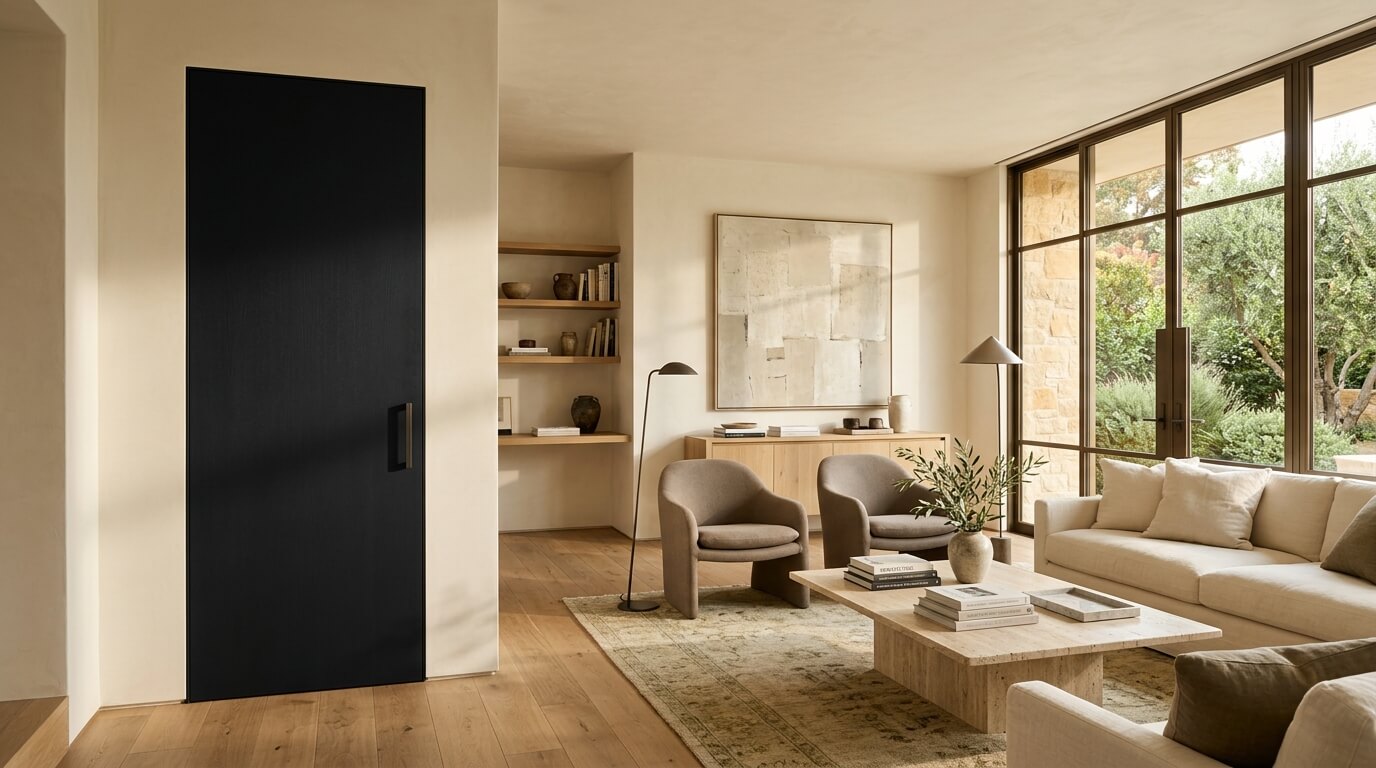
We’ve seen black interior doors look completely natural inside coastal California homes filled with pale oak flooring and linen furniture. We’ve seen them soften contemporary spaces dominated by concrete and glass. They even manage to bring surprising balance to carefully renovated historic homes where original architectural details remain intact.
Good design doesn’t spend much time worrying about labels. It worries about relationships. One material talking politely to another. Sometimes arguing but mostly cooperating.
The Rest of the Room Begins Behaving Differently
This is something people rarely expect. Install black interior doors, and suddenly every surrounding finish starts reacting.
Brass hardware becomes warmer. Natural oak appears lighter. White walls gain crispness. Stone surfaces reveal patterns that previously hid in plain sight. The doors themselves haven’t changed—they simply encourage everything else to become slightly more expressive.
Design can be wonderfully manipulative like that.
Hardware Deserves More Thought Than It Usually Gets
Door hardware has an unfortunate habit of being selected somewhere near the end of a project, usually when everyone involved is already exhausted. Bad timing because hardware completely changes how black doors feel.
Soft bronze introduces warmth. Satin stainless steel adds precision. Matte black creates an almost sculptural appearance where the handle nearly disappears into the door itself, leaving form rather than decoration to define the experience.
Tiny decisions, noticeable consequences. Construction is basically thousands of tiny decisions working together.
Balance Is More Important Than Matching
One mistake appears surprisingly often. Someone installs black doors and then immediately begins searching for more black objects because surely everything has to match now.
Not really. Actually, usually not.
Luxury interiors rarely depend on perfect matching. They depend on thoughtful balance. Lumber flooring, textured plaster, natural limestone, warm fabrics, carefully controlled lighting—these elements prevent black interior doors from becoming isolated statements.
Contrast needs companionship, otherwise it starts looking lonely.
Shadows Become Part of the Design
Architects spend years studying light. They should probably spend equal time studying shadows.
A shadow isn’t simply the absence of light. It’s another material, just one that keeps changing its mind. Dark doors interact beautifully with shadows because the boundary between the two becomes wonderfully uncertain. Edges soften. Hallways gain depth. Corners feel calmer. The house begins changing character every few hours without anyone lifting a finger.
Quality Becomes Impossible to Hide
Or impossible to fake. One of those. Because black interior doors naturally emphasize edges, reveals, and alignment, poor workmanship becomes surprisingly obvious. Tiny inconsistencies that might disappear beneath lighter finishes suddenly introduce themselves rather enthusiastically.
That’s not necessarily bad news. It simply means precision matters. Actually, precision always matters—black just refuses to let anyone forget.
They Age Differently Than Trends
Some design ideas announce the exact year they became fashionable. Remember glossy cherry cabinets? Exactly.
Black interior doors behave differently because black itself rarely goes out of style. What changes is how designers use it. Twenty years from now the surrounding furniture will evolve. Paint colors will drift toward new preferences. Lighting technology will continue doing whatever lighting technology always seems determined to do.
The doors will probably remain convincing. That’s a worthwhile investment. Not because timelessness is magical—it isn’t—but because constantly chasing trends becomes exhausting after a while. Homes deserve a little peace too.
Living With Them Is Surprisingly Easy
People worry about fingerprints. Dust. Maintenance. Life, generally. Honestly, premium matte finishes have become remarkably forgiving. They hide daily wear better than many glossy alternatives, and regular care quickly becomes part of ordinary routines rather than some elaborate maintenance ritual.
Besides, homes are supposed to be lived in. If every surface remains permanently untouched, something has probably gone wrong. Or everyone went on vacation.
They Create Presence Without Raising Their Voice
Perhaps that’s what makes black interior doors so compelling. They don’t rely on ornament. They don’t chase attention. They simply occupy their place with remarkable certainty, allowing the surrounding architecture to become stronger almost by association. Like that one person at a dinner party who barely speaks for the first hour, then says a single thoughtful sentence and somehow changes the entire conversation.
Good architecture occasionally behaves exactly the same way.
A black door catches your eye at first. Then, after you’ve lived with it for months, maybe years, you stop noticing the color altogether. What remains is proportion. Rhythm. Calm. The rooms feel complete in a way that’s surprisingly difficult to explain, rather like the Pacific just before sunset—never perfectly still, never trying to impress anyone, yet somehow impossible to look away from.