People love asking which option is better. Frameless or framed? It’s a perfectly reasonable question. Also a slightly dangerous one.
Not because there’s a wrong answer. There usually isn’t. It’s dangerous because it assumes every home wants the same thing. Homes don’t. Neither do homeowners. One family wants every room to disappear into clean architectural lines. Another wants warmth, visible craftsmanship, and details that quietly announce themselves without shouting across the room.
Both can be beautiful. Very beautiful. That’s the inconvenient part about good design—it rarely gives you one obvious answer.
The discussion around frameless vs framed doors comparison has become much more common over the last few years, especially as European interior doors continue gaining popularity across the United States. Modern architecture has shifted toward cleaner surfaces, thinner details, fewer interruptions. Suddenly homeowners who never imagined themselves thinking about door frames are standing in showrooms thinking about the differences.
It isn’t really about doors. Not entirely. It’s about how you want your home to feel every single day.
Why Interior Doors Suddenly Became Design Features
For decades, interior doors were mostly practical. Open. Close. Repeat. Nobody expected them to contribute much to the design. They simply existed.
Meanwhile kitchens became larger, flooring improved, windows expanded, lighting became architectural, and furniture slowly adopted cleaner lines. The rest of the house evolved while interior doors quietly stayed behind.
Then modern European design arrived. Or rather Americans finally started paying closer attention to it. Flush doors. Hidden hinges. Magnetic latches. Minimal hardware. Walls and doors beginning to work together instead of competing for attention.
It completely changed the conversation.
Architecture Has Become Simpler
Walk through a newly renovated home today. Notice something. There are fewer decorative interruptions. Trim becomes thinner, cabinets lose unnecessary ornament, walls appear cleaner. Lighting hides inside ceilings instead of hanging from them. Everything seems calmer. Frameless doors naturally belong in this movement because they remove visual boundaries instead of adding them.
Framed doors, on the other hand, continue offering timeless structure and definition. Neither approach is outdated. They’re simply speaking different architectural languages.
What Is a Framed Interior Door?
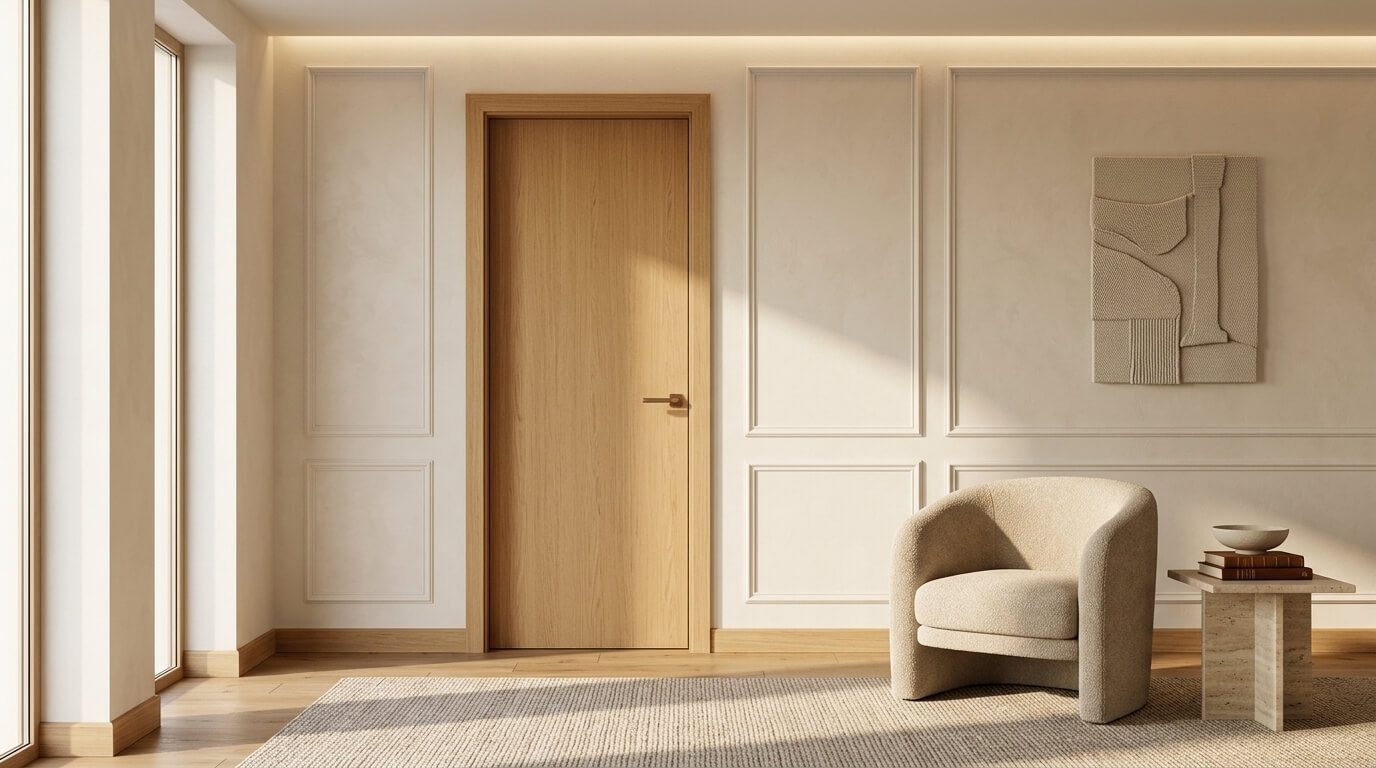
Let’s begin with the familiar option. A framed interior door includes a visible jamb and casing surrounding the opening. You’ve seen them thousands of times, probably without noticing.
Traditional framed doors create a clear transition between rooms. The opening becomes intentional. Defined. Comfortable. There’s something reassuring about visible structure.
People have been building doors this way for centuries. Sometimes tradition survives because it still works.
Why Framed Doors Remain Popular
Framed systems are wonderfully adaptable. Traditional homes love them. Transitional interiors appreciate them. Farmhouse styles welcome them. Even many contemporary spaces continue using framed European doors because the visible casing complements the surrounding trim beautifully.
Frames create rhythm throughout the house. Every doorway becomes part of a repeating architectural pattern. Consistency feels satisfying.
Our minds enjoy repetition more than we admit.
They Can Still Feel Modern
Here’s a common misconception. Framed does not automatically mean traditional. Not anymore.
Modern European framed doors often feature flush slabs, concealed hinges, slim casings, and minimalist hardware that feel every bit as contemporary as frameless systems. The frame simply becomes quieter, less decorative. Almost understated.
What Is a Frameless Interior Door?
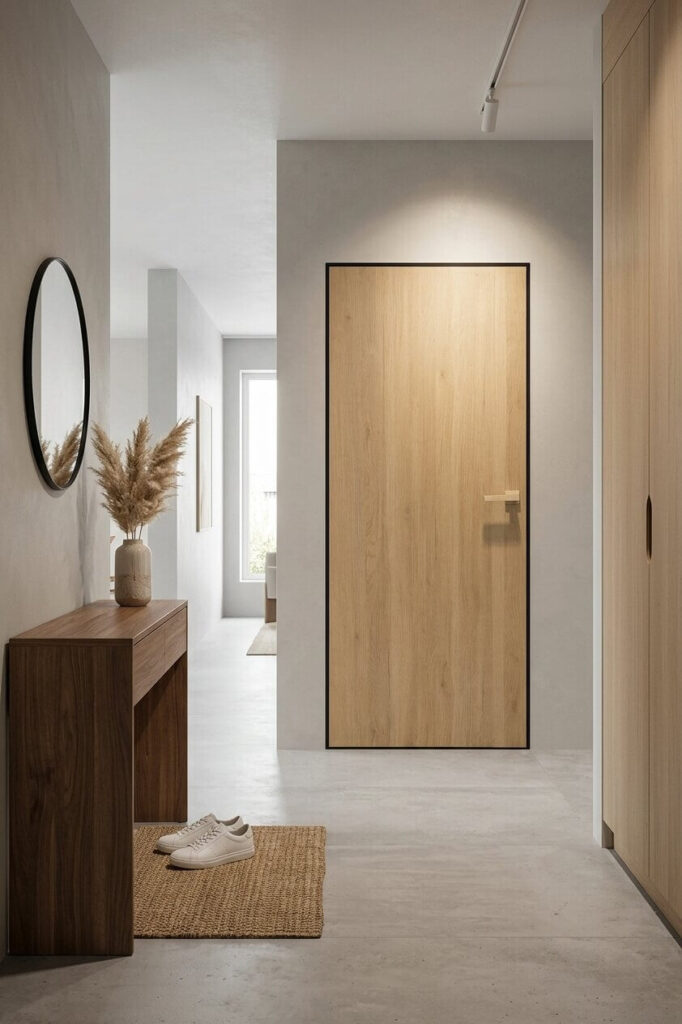
Frameless interior doors—sometimes called invisible doors or hidden frame doors—remove the traditional casing almost entirely.
The frame disappears inside the wall. The door sits nearly flush with the surrounding surface. Closed, it becomes part of the architecture rather than an object attached to it. It’s a subtle effect. Remarkably subtle. Until you experience it in person. Then suddenly every traditional casing begins looking too bulky..
Walls Become the Main Feature
Frameless systems allow the wall to remain visually uninterrupted. Instead of stopping at every doorway, your eyes continue moving naturally across the room. Spaces appear larger. Cleaner. Quieter.
Not physically larger, of course. Architecture occasionally performs little optical tricks. This happens to be one of its best.
Minimalism Without Feeling Cold
Some homeowners worry frameless doors will make the house feel sterile. That’s understandable. It’s also usually untrue.
Minimalism isn’t about removing personality—it’s about removing distractions. There’s a meaningful difference hiding inside those two ideas. Warm wood veneers. Natural light. Soft paint colors. Beautiful flooring. Those elements become more noticeable precisely because the door isn’t demanding additional attention.
Sometimes subtraction creates warmth.
Frameless vs Framed Doors: The Biggest Differences
The conversation around frameless vs framed doors comparison isn’t really about choosing the more expensive option. It’s about choosing the one that belongs in your home.
Architecture always comes first. Everything else follows.
Visual Appearance
This is the obvious distinction. Framed doors celebrate the opening, frameless doors almost erase it. Neither philosophy is wrong.
Think of picture frames. Some artwork benefits enormously from one. Other pieces seem stronger floating without it. Doors behave similarly.
Installation Complexity
Frameless systems require greater precision. Much greater.
Hidden aluminum frames integrate directly into the wall construction or renovation process. Measurements become critical. Wall preparation becomes critical. Alignment becomes critical. Millimeters matter a lot throughout every premium installation.
Framed systems generally allow slightly more flexibility because visible casing can conceal small irregularities. Frameless architecture has nowhere to hide. That’s both its greatest strength and its greatest challenge.
Hardware
Premium framed and frameless European doors frequently share similar high-end hardware. Concealed hinges. Magnetic latches. Luxury handles. Smooth operation. The difference lies less in the hardware itself than in how that hardware integrates into the surrounding architecture.
Frameless systems make everything disappear. Framed systems simply organize it beautifully.
Which Homes Look Best With Frameless Doors?
Not every house needs invisible doors. Some absolutely flourish with them.
Contemporary Architecture
Large windows, open floor plans, thin trim, natural stone, minimal cabinetry—these homes almost invite frameless systems.
Everything already emphasizes uninterrupted surfaces. The doors simply continue the conversation.
Luxury Custom Homes
Many custom residences now use frameless European doors throughout main living areas because they create extraordinary visual continuity.
Hallways feel longer. Walls appear cleaner. Ceilings seem taller. Guests often notice something feels unusually elegant without immediately identifying why. Invisible design can be surprisingly memorable.
Homes Filled With Art
Here’s an unexpected advantage. Frameless doors allow artwork, furniture, and architecture to become the stars of the room. The doors politely step aside.
Good supporting actors deserve awards too.
Which Homes Benefit From Framed Doors?
Quite a few. Perhaps more than social media suggests.
Transitional Interiors
Many homeowners blend contemporary furniture with classic architectural details. Framed European doors fit beautifully into this balance. They provide enough definition to complement traditional elements while remaining clean enough for modern interiors.
Balance has always been more difficult than extremes. Also more rewarding.
Renovated Family Homes
Not every renovation begins with new construction. Existing trim. Original moldings. Classic proportions. Framed doors often integrate more naturally into homes where preserving architectural character matters.
Updating doesn’t always mean replacing everything. Sometimes respecting history creates the strongest result.
Homes That Value Texture
Visible frames add rhythm. Shadow lines. Architectural layering. Some spaces simply feel better with those details.
Minimalism isn’t a universal prescription. Nor should it be.
Sound, Privacy, and Performance
Here’s the good news. Both premium framed and frameless European systems can provide outstanding performance.
Solid-core construction improves sound control regardless of frame style. Magnetic latches create quieter operation. Precision manufacturing enhances durability. Performance depends far more on quality than appearance. A beautiful door still needs to function beautifully.
Every day. For years.
Installation Changes Everything
This deserves repeating. The finest frameless door installed carelessly becomes frustrating. The finest framed door installed carelessly does exactly the same.
Premium installation determines alignment, hardware performance, reveal consistency, acoustic performance, and long-term reliability. Architecture forgives very little—especially when the design becomes simpler.
Which Option Adds More Value?
Interesting question. Perhaps the wrong one. The better question asks which system fits the home.
Luxury buyers appreciate authenticity. A sleek contemporary residence often feels more complete with frameless doors. A beautifully renovated transitional home may feel stronger with elegant framed European systems.
Consistency creates value. Mismatch creates hesitation. Homes speak most confidently when every detail agrees with the others.
How Diana Doors Helps Homeowners Choose
At Diana Doors, conversations about frameless vs framed doors comparison rarely begin with product catalogs. They begin with the house. Its architecture. Its lighting. Its proportions. The way people actually live inside it.
Sometimes homeowners arrive absolutely convinced they want frameless doors. Then they see premium framed European systems that perfectly complement their home’s character. Other times the opposite happens. One walk through a frameless display and suddenly the entire renovation makes sense. That’s why seeing both options in person matters.
We offer premium European interior door systems in both framed and frameless configurations, featuring solid-core construction, concealed hinges, magnetic latches, luxury hardware, architectural painted finishes, and exceptional natural wood veneers. Every system is professionally installed because precision isn’t simply part of the experience—it is the experience.
There isn’t a universally correct answer waiting somewhere on the internet, hiding behind another article or another comparison chart. There is only the answer that belongs to your home. Maybe it’s the quiet confidence of invisible frameless architecture, where walls flow uninterrupted and doors almost disappear into them like good editing in a favorite novel. Maybe it’s the timeless rhythm of beautifully proportioned framed doors, creating structure and warmth without ever feeling heavy or old-fashioned.
Either way, the best decision usually feels strangely obvious once you’re standing in the right space. You stop comparing photographs. Stop chasing trends. Stop wondering what everyone else is choosing. The house quietly tells you what it wants. You listen. And somehow the conversation becomes remarkably simple.